Proof. We need the following lemma.
Lemma: In triangle ABC, let I be the incenter. The incircle ⊙I is tangent to sides BC, CA, AB at points A1, B1, C1, respectively. Let A1I intersect B1C1 at L. Then, AL passes through the midpoint M of BC.
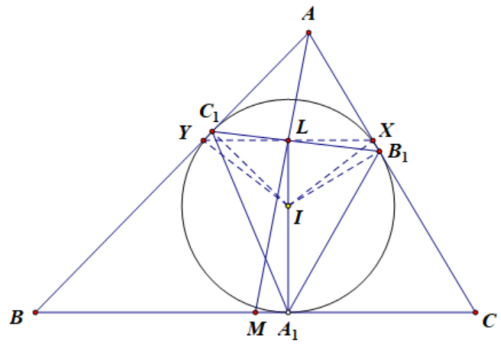
Proof of lemma: Draw a line through L parallel to BC, intersecting AC at X and AB at Y. Connect IB1, IC1, IX, and IY.
Since A1L⊥BC and XY∥BC, we know that A1L⊥XY. Thus, ∠ILX=∠IB1X=90∘, and I,L,X,B1 are concyclic. Similarly, I,L,C1,Y are concyclic. Therefore, ∠IXB1=∠ILB1=∠IYC1.
Combining this with ∠IB1X=∠IC1Y=90∘ and IB1=IC1, we have △IB1X≅△IC1Y. Thus, IX=IY.
Also, note that IL⊥XY, so L is the midpoint of XY. Combined with XY∥BC, we conclude that AL passes through the midpoint M of BC. The lemma is proven.
Returning to the original problem, let the incircle ⊙I of triangle ABC be tangent to sides BC, CA, AB at points A1, B1, C1, respectively. By the lemma, L is on segment B1C1. Let S be the midpoint of BI, and let T be a point on AS such that ∠TBS=∠BAS.
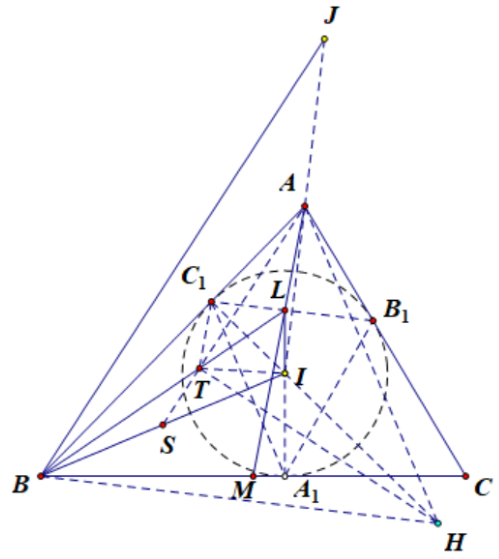
We will now prove that points B, T, L are collinear.
Since ∠TBS=∠BAS, we know △BST∼△ASB. Thus, BS2=SA⋅ST. Also, BS=SI, so IS2=SA⋅ST. This implies △IST∼△ASI, and therefore,
∠BTI=∠BTS+∠ITS=∠ABI+∠AIB=180∘−∠BAI.
Let H be the orthocenter of triangle AIB. By the properties of the orthocenter, ∠BHI=∠BAI. Thus, points B, T, I, H are concyclic. Therefore, ∠STH=∠BTH−∠BTS=∠BIH−∠ABI=90∘, and combined with ∠AC1H=90∘, we have points A, C1, T, H concyclic, with AH being the diameter of the circle.
Thus,
∠ITC1=∠HTC1−∠HTI=180∘−∠HAC1−∠HBI=180∘−(90∘−∠ABI)−(90∘−∠ABI−∠BAI)=2∠ABI+∠BAI.
Moreover, note that
∠ILB1=∠IC1L+∠LIC1=21∠BAC+∠ABA1=∠BAI+2∠ABI.
So ∠ITC1=∠ILB1, so I, T, C1, L are concyclic. From this, we deduce ∠ITL=∠IC1L=∠BAI. Therefore, points B, T, L are collinear, and ∠LBI=∠TBI=∠BAS.
Since AS is the median of triangle BIJ, we have AS∥BJ, and ∠BAS=∠ABJ. Therefore, ∠ABJ=∠LBI. The conclusion is proven. □