Find the maximum possible area of a right-angled triangle that can be covered by two closed disks of radius .
CGMO, 2024
Solution
Proof. Let the right triangle be with . In this solution, the interior of a triangle or a circle includes its boundary.
Let and be the circumferences of two closed disks with radius , such that every point inside lies in the interior of or in the interior of . The distance between any two points within the same disk does not exceed .
Consider the assignment of the three vertices , , and .
If and lie in the same disk, then the length of the hypotenuse , and the area .
If and do not lie in the same disk, assume lies inside and lies inside . Without loss of generality, let the right-angled vertex lie inside . Since lies outside , the line segment intersects the circumference at a unique point . The point divides into two segments and , where lies inside , and (excluding the endpoint ) lies outside and must therefore lie inside . Consequently, the endpoint also lies inside .
Since both and lie inside , we have ; similarly, since both and lie inside , we have .
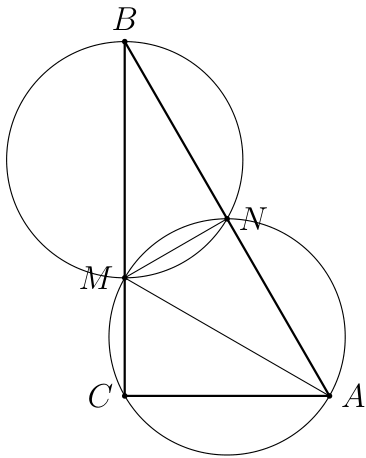
On the other hand, let be the foot of the perpendicular from to . The circle with diameter covers , and the circle with diameter covers the quadrilateral . Thus, these two disks together cover . Therefore, the problem reduces to finding a point on the side such that .
Let and . Then , and
Thus, . Equality holds when and , corresponding to the side lengths , , and , with the point on satisfying and . In this case, can be covered by two closed disks of radius (i.e., the disks with diameters and ), fulfilling the requirement.
Therefore, the maximum possible area of the right triangle is .
Want a route through all this instead of an archive? The track
puts 2,604 problems in a working order, from Junior Challenge level to the IMO shortlist.