Maths Olympiad Prep

Library / /40 of 55

, 2016

Geometry Difficulty 8.9 Shortlist Prove it IMO

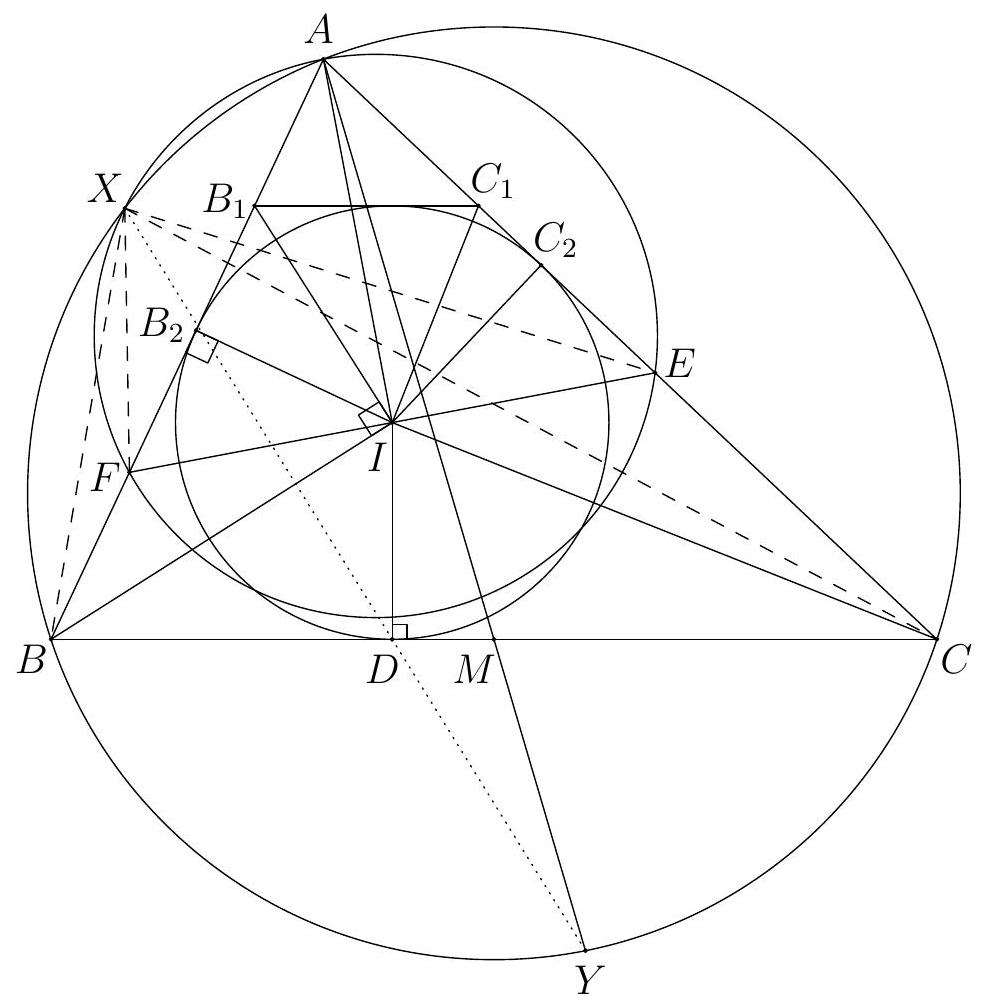
Let ABCABC be a triangle with circumcircle Γ\Gamma and incentre II. Let MM be the midpoint of side BCBC. Denote by DD the foot of perpendicular from II to side BCBC. The line through II perpendicular to AIAI meets sides ABAB and ACAC at FF and EE respectively. Suppose the circumcircle of triangle AEFAEF intersects Γ\Gamma at a point XX other than AA. Prove that lines XDXD and AMAM meet on Γ\Gamma.

Solutions — 2

Solution 1

Let AMAM meet Γ\Gamma again at YY and XYXY meet BCBC at DD'. It suffices to show D=DD' = D. We shall apply the following fact.

- Claim. For any cyclic quadrilateral PQRSPQRS whose diagonals meet at TT, we have
QTTS=PQQRPSSR \frac{QT}{TS} = \frac{PQ \cdot QR}{PS \cdot SR}
Proof. We use [W1W2W3][W_1 W_2 W_3] to denote the area of W1W2W3W_1 W_2 W_3. Then
QTTS=[PQR][PSR]=12PQQRsinPQR12PSSRsinPSR=PQQRPSSR \frac{QT}{TS} = \frac{[PQR]}{[PSR]} = \frac{\frac{1}{2} PQ \cdot QR \sin \angle PQR}{\frac{1}{2} PS \cdot SR \sin \angle PSR} = \frac{PQ \cdot QR}{PS \cdot SR}
Applying the Claim to ABYCABYC and XBYCXBYC respectively, we have 1=BMMC=ABBYACCY1 = \frac{BM}{MC} = \frac{AB \cdot BY}{AC \cdot CY} and BDDC=XBBYXCCY\frac{BD'}{D'C} = \frac{XB \cdot BY}{XC \cdot CY}. These combine to give
BDCD=XBXCBYCY=XBXCACAB \begin{equation*} \frac{BD'}{CD'} = \frac{XB}{XC} \cdot \frac{BY}{CY} = \frac{XB}{XC} \cdot \frac{AC}{AB} \tag{1} \end{equation*}
Next, we use directed angles to find that XBF=XBA=XCA=XCE\measuredangle XBF = \measuredangle XBA = \measuredangle XCA = \measuredangle XCE and XFB=XFA=XEA=XEC\measuredangle XFB = \measuredangle XFA = \measuredangle XEA = \measuredangle XEC. This shows triangles XBFXBF and XCEXCE are directly similar. In particular, we have
XBXC=BFCE \begin{equation*} \frac{XB}{XC} = \frac{BF}{CE} \tag{2} \end{equation*}
In the following, we give two ways to continue the proof.

- Method 1. Here is a geometrical method. As FIB=AIB90=12ACB=ICB\angle FIB = \angle AIB - 90^{\circ} = \frac{1}{2} \angle ACB = \angle ICB and FBI=IBC\angle FBI = \angle IBC, the triangles FBIFBI and IBCIBC are similar. Analogously, triangles EICEIC and IBCIBC are also similar. Hence, we get
FBIB=BIBC and ECIC=ICBC \begin{equation*} \frac{FB}{IB} = \frac{BI}{BC} \quad \text{ and } \quad \frac{EC}{IC} = \frac{IC}{BC} \tag{3} \end{equation*}
Figure 1
Next, construct a line parallel to BCBC and tangent to the incircle. Suppose it meets sides ABAB and ACAC at B1B_1 and C1C_1 respectively. Let the incircle touch ABAB and ACAC at B2B_2 and C2C_2 respectively. By homothety, the line B1IB_1I is parallel to the external angle bisector of ABC\angle ABC, and hence B1IB=90\angle B_1IB = 90^{\circ}. Since BB2I=90\angle BB_2I = 90^{\circ}, we get BB2BB1=BI2BB_2 \cdot BB_1 = BI^2, and similarly CC2CC1=CI2CC_2 \cdot CC_1 = CI^2. Hence,
BI2CI2=BB2BB1CC2CC1=BB1CC1BDCD=ABACBDCD. \begin{equation*} \frac{BI^2}{CI^2} = \frac{BB_2 \cdot BB_1}{CC_2 \cdot CC_1} = \frac{BB_1}{CC_1} \cdot \frac{BD}{CD} = \frac{AB}{AC} \cdot \frac{BD}{CD} . \tag{4} \end{equation*}
Combining (1), (2), (3) and (4), we conclude
BDCD=XBXCACAB=BFCEACAB=BI2CI2ACAB=BDCD \frac{BD'}{CD'} = \frac{XB}{XC} \cdot \frac{AC}{AB} = \frac{BF}{CE} \cdot \frac{AC}{AB} = \frac{BI^2}{CI^2} \cdot \frac{AC}{AB} = \frac{BD}{CD}
so that D=DD' = D. The result then follows.

- Method 2. We continue the proof of Solution 1 using trigonometry. Let β=12ABC\beta = \frac{1}{2} \angle ABC and γ=12ACB\gamma = \frac{1}{2} \angle ACB. Observe that FIB=AIB90=γ\angle FIB = \angle AIB - 90^{\circ} = \gamma. Hence, BFFI=sinFIBsinIBF=sinγsinβ\frac{BF}{FI} = \frac{\sin \angle FIB}{\sin \angle IBF} = \frac{\sin \gamma}{\sin \beta}. Similarly, CEEI=sinβsinγ\frac{CE}{EI} = \frac{\sin \beta}{\sin \gamma}. As FI=EIFI = EI, we get
BDCD=ACAB(sinγsinβ)2=sin2βsin2γ(sinγsinβ)2=tanγtanβ=ID/CDID/BD=BDCD. \frac{BD'}{CD'} = \frac{AC}{AB} \cdot \left(\frac{\sin \gamma}{\sin \beta}\right)^2 = \frac{\sin 2\beta}{\sin 2\gamma} \cdot \left(\frac{\sin \gamma}{\sin \beta}\right)^2 = \frac{\tan \gamma}{\tan \beta} = \frac{ID / CD}{ID / BD} = \frac{BD}{CD} .
This shows D=DD' = D and the result follows.

Solution 2

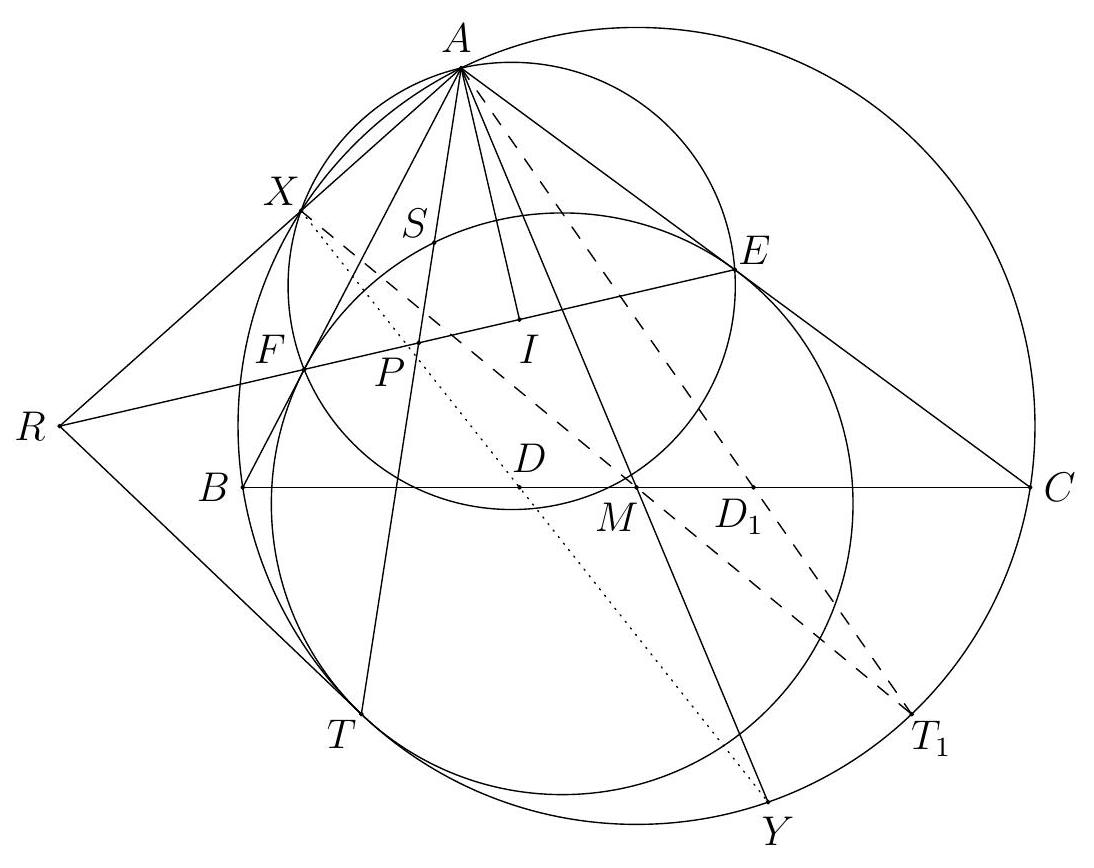
Let ωA\omega_A be the AA-mixtilinear incircle of triangle ABCABC. From the properties of mixtilinear incircles, ωA\omega_A touches sides ABAB and ACAC at FF and EE respectively. Suppose ωA\omega_A is tangent to Γ\Gamma at TT. Let AMAM meet Γ\Gamma again at YY, and let D1,T1D_1, T_1 be the reflections of DD and TT with respect to the perpendicular bisector of BCBC respectively. It is well-known that BAT=D1AC\angle BAT = \angle D_1AC so that A,D1,T1A, D_1, T_1 are collinear.
Figure 2
We then show that X,M,T1X, M, T_1 are collinear. Let RR be the radical centre of ωA,Γ\omega_A, \Gamma and the circumcircle of triangle AEFAEF. Then RR lies on AX,EFAX, EF and the tangent at TT to Γ\Gamma. Let ATAT meet ωA\omega_A again at SS and meet EFEF at PP. Obviously, SFTESFTE is a harmonic quadrilateral. Projecting from TT, the pencil (R,P;F,ER, P ; F, E) is harmonic. We further project the pencil onto Γ\Gamma from AA, so that XBTCXBTC is a harmonic quadrilateral. As TT1BCTT_1 \parallel BC, the projection from T1T_1 onto BCBC maps TT to a point at infinity, and hence maps XX to the midpoint of BCBC, which is MM. This shows X,M,T1X, M, T_1 are collinear.
We have two ways to finish the proof.

- Method 1. Note that both AYAY and XT1XT_1 are chords of Γ\Gamma passing through the midpoint MM of the chord BCBC. By the Butterfly Theorem, XYXY and AT1AT_1 cut BCBC at a pair of symmetric points with respect to MM, and hence X,D,YX, D, Y are collinear. The proof is thus complete.

- Method 2. Here, we finish the proof without using the Butterfly Theorem. As DTT1D1DTT_1D_1 is an isosceles trapezoid, we have
YTD=YTT1+T1TD=YAT1+AD1D=YMD \measuredangle YTD = \measuredangle YTT_1 + \measuredangle T_1TD = \measuredangle YAT_1 + \measuredangle AD_1D = \measuredangle YMD
so that D,T,Y,MD, T, Y, M are concyclic. As X,M,T1X, M, T_1 are collinear, we have
AYD=MTD=D1T1M=AT1X=AYX \measuredangle AYD = \measuredangle MTD = \measuredangle D_1T_1M = \measuredangle AT_1X = \measuredangle AYX
This shows X,D,YX, D, Y are collinear.

Want a route through all this instead of an archive? The track puts 2,000 problems in a working order, from AMC 10 level to the IMO shortlist.

Source: MathNet, licensed CC-BY-4.0. Statement and solution reproduced as published; topic and difficulty added by this site.