There are new students. Suppose that there are two students who know each other in every three students and there are two students who do not know each other in every four students. Find the maximum value of . (posed by Tang Lihua)
China Western Mathematical Olympiad
Solution
The maximum value of is .
When , the example shown in the diagram satisfies the requirements, where represent students. The line segment between and means and know each other.
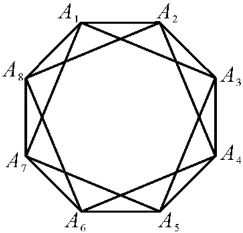
Next, if students satisfy the conditions, we want to show that . To do this, we first prove that the following two cases are impossible.
(1) If someone knows at least persons, denoted by . By Ramsey's theorem, there exist persons among them who do not know each other. This contradicts that there are two who know each other in every three students, or that there exist people they know each other. and the three persons form a group of four persons such that every two of them know each other. A contradiction.
(2) If some one knows at most persons, then in the remaining there are at least persons, none of whom knows . Thus every two of the four persons know each other, a contradiction.
When , one of (1) and (2) must occur. So such does not satisfy the requirements.
If , in order to avoid (1) and (2), each person knows exactly other persons. Thus the number of pairs knowing each other is . This contradiction implies . Thus the maximum value of is .
Want a route through all this instead of an archive? The track
puts 2,604 problems in a working order, from Junior Challenge level to the IMO shortlist.