The square divides the circle into four arcs. None of them can contain more than one of the triangle vertices, because the distance between two triangle vertices is equivalent to an inner angle of 120∘, whereas the distance between two vertices of the square is only equivalent to an inner angle of 90∘. Therefore, the triangle vertices must be on three distinct parts of the circle.
Let ABCD denote the square and let PQR denote the triangle. Without loss of generality, let us assume that P is on the arc between A and B, that Q is between B and C, and that R is between D and A, as shown in the graph below.
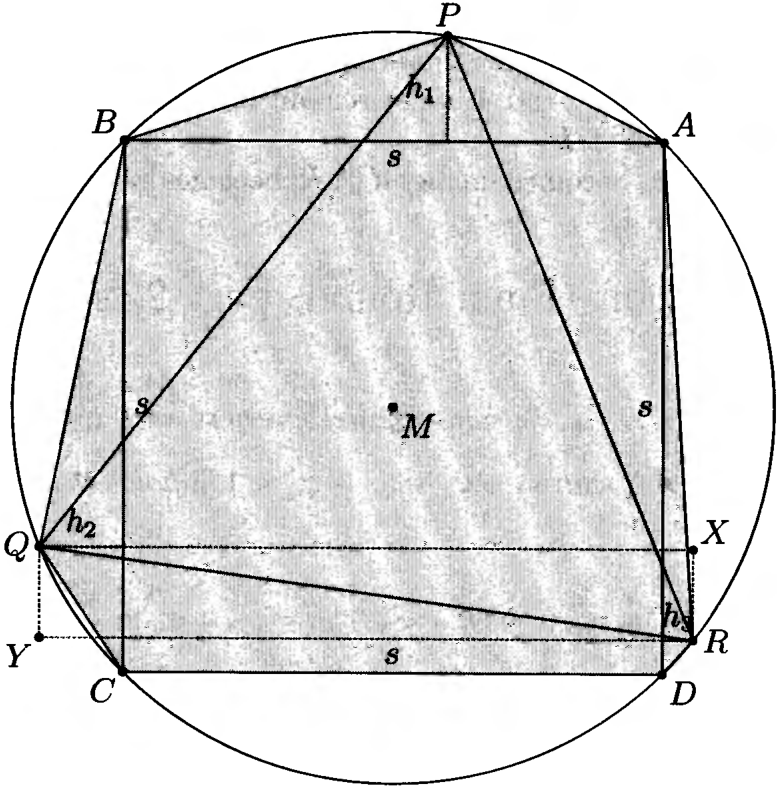
We see that the heptagon is combined of the square ABCD and the three triangles APB, BQC and DRA. Since the size of the square ABCD is constant, it is sufficient to maximize resp. minimize the sum of the areas of these three triangles.
Let h1 denote the distance between point P and line AB (i.e., the height of triangle APB), let h2 denote the distance between point Q and line BC, and let h3 denote the distance between point R and line DA. The sum of the areas of the three triangles can thus be calculated as 2∣AB∣⋅h1+2∣BC∣⋅h2+2∣DA∣⋅h3=2s⋅(h1+h2+h3), where s denotes the length of each side of the square. Since s is constant, it is therefore sufficient to maximize resp. minimize the sum (h1+h2+h3).
We will do this by separately maximizing resp. minimizing the height h1, and the sum of the heights h2+h3.
The height h1 is largest when P is exactly in the middle of the arc between A and B.
For maximizing the sum h2+h3, consider the rectangle QXRY with sides parallel to the sides of the square ABCD and with QR as one of its diagonals. By Pythagoras it holds that ∣QR∣2=∣QX∣2+∣XR∣2=(h1+s+h2)2+∣XR∣2, and therefore (h2+s+h3)2=∣QR∣2−∣XR∣2. Since the length of the triangle side QR is constant, the expression (and consequently the sum h2+h3) is largest when ∣XR∣=0. This is the case if side QR is parallel to side CD, or equivalently, if P is exactly in the middle of the arc between A and B.
Since h1 and the sum h2+h3 are both maximized in the same case, the sum of all three is also largest when P is exactly in the middle of the arc between A and B.
For determining the minimum, we again separately look at h1 and the sum h2+h3 and minimize them under the condition that the triangle vertices must remain on the correct parts of the circle.
The height h1 becomes smaller the closer P moves towards either A or B. Since Q must remain between B and C, and R must remain between D and A, the minimum is reached if either Q=C or R=D.
Likewise, the sum h2+h3 becomes smaller if ∣XR∣ becomes larger, so again the minimum is reached if Q=C or R=D. □