We call a convex pentagon in the Euclidean plane "special" if either all of its sides are of equal length or all of its interior angles are equal. We call it "very special" if either all of its sides are of equal length and two of its interior angles equal or if all of its interior angles are equal and two of its sides of equal length. Prove that every very special pentagon must have an axis of symmetry.
AustriaMO
Solution
Let the pentagon have the vertices , , , and in this order. We first assume that all sides are of equal length and two angles equal.
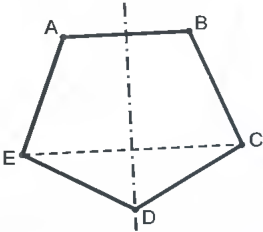
If the two equal angles are adjacent, we can place them at and without loss of generality. In this case, is an equilateral trapezoid with the common bisector of and as axis of symmetry. Since is isosceles with base , this line is also the axis of symmetry of and therefore of the entire pentagon , as required.
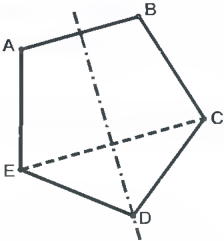
If the two equal angles are not adjacent, we can place them at and . Since triangle and are congruent (SAS) in this case, segments and are of equal length, and triangle is isosceles with base . The bisector of is therefore an axis of symmetry of , and since reflection on this line exchanges and , such a reflection also exchanges the congruent isosceles triangles and . It follows that the bisector of is the axis of symmetry for the entire pentagon as required.
We now assume that all angles are equal and two sides are of equal length.
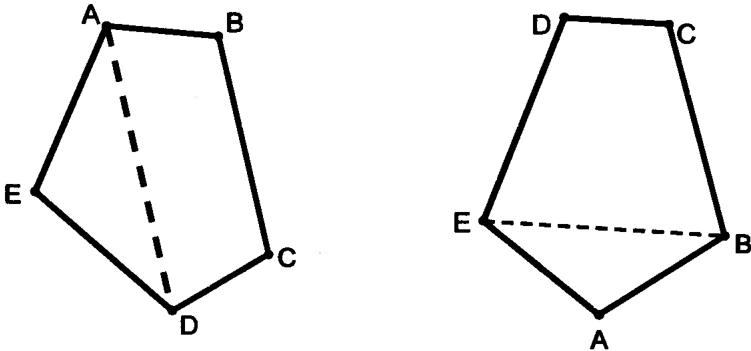
If the two sides are adjacent, we can place them at and . The triangle is then isosceles with base , and the bisector of is the axis of symmetry of . Furthermore, it immediately follows that is an isosceles trapezoid, since and hold, and this bisector is therefore also the axis of symmetry of this trapezoid, and therefore of the entire pentagon .
Finally, if the two sides are not adjacent, we can place them at and . Again, is an isosceles trapezoid and therefore isosceles, with common axis of symmetry in the bisector of , and this case is seen as analogous to the previous case.
Summing up, we see that every very special pentagon does indeed have an axis of symmetry, as claimed.
Want a route through all this instead of an archive? The track
puts 2,604 problems in a working order, from Junior Challenge level to the IMO shortlist.