Let be a convex quadrilateral inscribed in a circle . With centers the vertices of the quadrilateral and radius we draw circles , , , . Circles and meet at , circles and meet at , circles and meet at and the circles , meet at . (Points are the second common points of the corresponding circles, given that all of them pass through point ). Prove that the quadrilateral is parallelogram.
Greece — Selection Examination
Solutions — 2
Solution 1
The line segment connects the centers of the circles and , and therefore it is the perpendicular bisector of the common chord . Since the circles and have the same radius, the quadrilateral is rhombus. Thus point is the middle of .
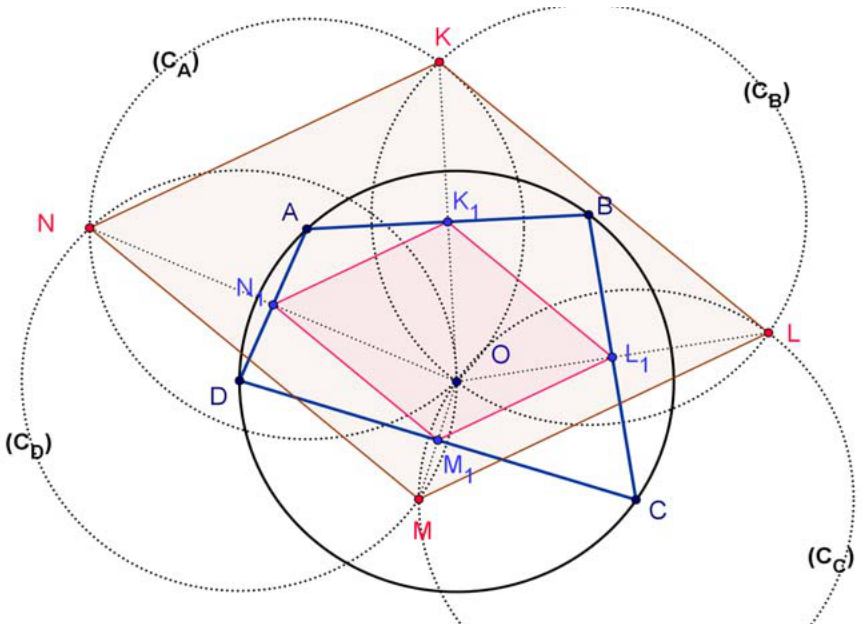
Similarly, we can show that is the middle of , is the middle of and is the middle of .
From the triangles , , and we conclude that: , , and (because the line segments , , and connect the middles of the sides of a triangle).
Hence the quadrilaterals and have their sides parallel. But we know that the middles of the sides of a quadrilateral define a parallelogram. So the quadrilateral is parallelogram.
Solution 2
Since the line segment is the common chord of the equal circles and , it is the perpendicular bisector of the line of the centers and vice versa.
Hence the quadrilateral is rhombus, and so
Similarly the quadrilateral is rhombus and
From (1) and (2) it follows that the quadrilateral is parallelogram, so
Working similarly we can prove that the quadrilateral is parallelogram and that
From (3) and (4) it follows that is parallelogram.
Want a route through all this instead of an archive? The track
puts 2,604 problems in a working order, from Junior Challenge level to the IMO shortlist.