Maths Olympiad Prep

Library / /33 of 48

Geometry Difficulty 6.5 National olympiad Prove it Greece

Let ABΓΔAB\Gamma\Delta be a quadrilateral inscribed into the circle. With centers A,B,Γ,ΔA, B, \Gamma, \Delta we draw circles CA,CB,CΓ,CΔC_A, C_B, C_\Gamma, C_\Delta respectively, not having common points. The circle CAC_A intersects the sides of the quadrilateral at the points A1,A2A_1, A_2, the circle CBC_B at the points B1,B2B_1, B_2, the circle CΓC_\Gamma at the points Γ1,Γ2\Gamma_1, \Gamma_2 and the circle CΔC_\Delta at the points Δ1,Δ2\Delta_1, \Delta_2. Prove that the quadrilateral created by the lines A1A2,B1B2,Γ1Γ2A_1A_2, B_1B_2, \Gamma_1\Gamma_2 and Δ1Δ2\Delta_1\Delta_2 is cyclic. (E. Psychas)

Solution

Since the triangles AA1A2,BB1B2,ΓΓ1Γ2AA_1A_2, BB_1B_2, \Gamma\Gamma_1\Gamma_2 and ΔΔ1Δ2\Delta\Delta_1\Delta_2 are isosceles, using small letters for their equal angles we have the equalities:
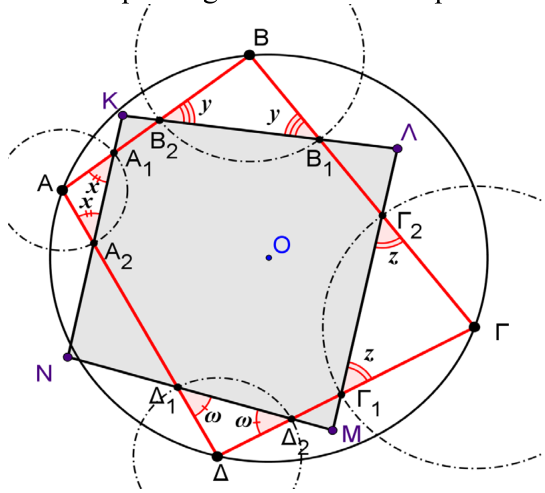
Figure 1
Figure 4
A^+x^+x^=180x^=90A^2(1)B^+y^+y^=180y^=90B^2(2) \hat{A} + \hat{x} + \hat{x} = 180^\circ \Leftrightarrow \hat{x} = 90^\circ - \frac{\hat{A}}{2} \quad (1) \qquad \hat{B} + \hat{y} + \hat{y} = 180^\circ \Leftrightarrow \hat{y} = 90^\circ - \frac{\hat{B}}{2} \quad (2)
Γ^+z^+z^=180z^=90Γ^2(3)Δ^+ω^+ω^=180ω^=90Δ^2(4). \hat{\Gamma} + \hat{z} + \hat{z} = 180^\circ \Leftrightarrow \hat{z} = 90^\circ - \frac{\hat{\Gamma}}{2} \quad (3) \qquad \hat{\Delta} + \hat{\omega} + \hat{\omega} = 180^\circ \Leftrightarrow \hat{\omega} = 90^\circ - \frac{\hat{\Delta}}{2} \quad (4).
Since the quadrilateral ABΓΔAB\Gamma\Delta is cyclic, we have:
A^+Γ^=180x^+z^=90(5)B^+Δ^=180y^+ω^=90(6). \hat{A} + \hat{\Gamma} = 180^\circ \Rightarrow \hat{x} + \hat{z} = 90^\circ \quad (5) \qquad \hat{B} + \hat{\Delta} = 180^\circ \Rightarrow \hat{y} + \hat{\omega} = 90^\circ \quad (6).
Let now the lines A1A2,B1B2,Γ1Γ2A_1A_2, B_1B_2, \Gamma_1\Gamma_2 form the quadrilateral KΛMNK\Lambda MN. From the triangle KA1B2KA_1B_2, we have: K^+x^+y^=180\hat{K} + \hat{x} + \hat{y} = 180^\circ, while from the triangle MΓ1Δ2M\Gamma_1\Delta_2, we have: M^+z^+ω^=180\hat{M} + \hat{z} + \hat{\omega} = 180^\circ. Summing up the last two relations and using (5) and (6) we obtain: K^+M^=180\hat{K} + \hat{M} = 180^\circ.

Want a route through all this instead of an archive? The track puts 2,000 problems in a working order, from AMC 10 level to the IMO shortlist.

Source: MathNet, licensed CC-BY-4.0. Statement and solution reproduced as published; topic and difficulty added by this site.