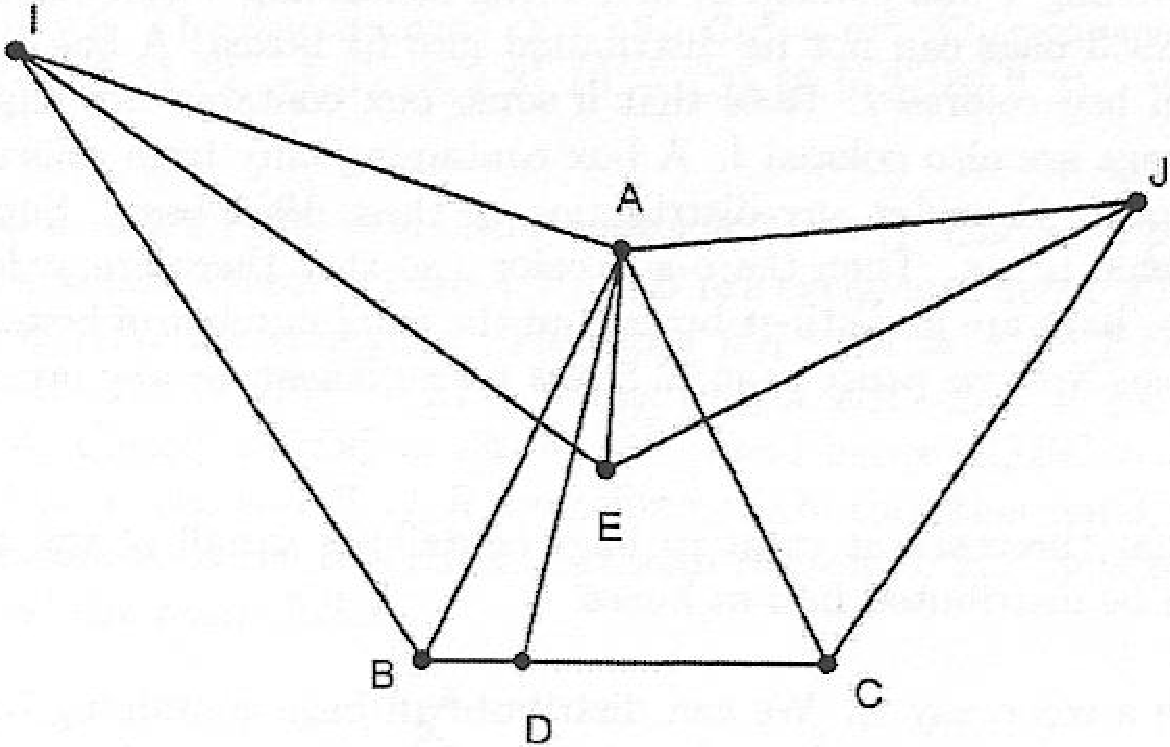
In an equilateral triangle ABC, let D be a point on the side [BC] other than the vertices. Let I be the excenter of the triangle ABD opposite to the side [AB] and J be the excenter of the triangle ACD opposite to the side [AC]. Let the circumcircles of the triangles AIB and AJC intersect at the point E for the second time. Prove that A is the incenter of the triangle IEJ.
Solution
First note that ∠IBA=∠JCA=60∘. Then ∠IEA=∠JEA=60∘ and ∠IEJ=120∘. Therefore A is on the angle bisector of the angle IEJ. Next observe that ∠IAD=90∘+∠BAD/2 and ∠JAD=90∘+∠CAD/2. Hence ∠IAJ=360∘−180∘−(∠BAD+∠DAC)/2=150∘ and therefore A is inside the triangle IEJ.
Let X be the incenter of the triangle IEJ. We know that X is inside the triangle IEJ and ∠IXJ=90∘+∠IEJ/2=150∘. Thus I, X, A, J are cyclic. Since E, X, A are collinear we get X=A as desired.
Want a route through all this instead of an archive? The track
puts 2,604 problems in a working order, from Junior Challenge level to the IMO shortlist.
Source: MathNet,
licensed CC-BY-4.0.
Statement reproduced verbatim; metadata (topic, difficulty) added by this project.