The quadrilateral ABCD is inscribed in the parabola . It is known that , the diagonal AC is parallel to the axis Ox and AC is the bisector of the angle BAD.
Find the area of the quadrilateral ABCD if the length of the diagonal BD is equal to p.
Belarusian Mathematical Olympiad
Solution
Answer: .
Note that if the points with coordinates and belong to the parabola , then the line passing through them has the equation . Indeed, since the coordinates of each of the two points satisfy this linear equation, the entire line is given by this equation.
Denote the coordinates of the points: , , , (we take into account that , so points and are symmetric with respect to ). The line has the equation . On the other hand, from the conditions , so the slope of this line equals to , i.e. . Similarly the line has the equation and its slope equals to , so . Denote the points and (see the Fig.). From the right triangle we get . Since and it follows that , whence .
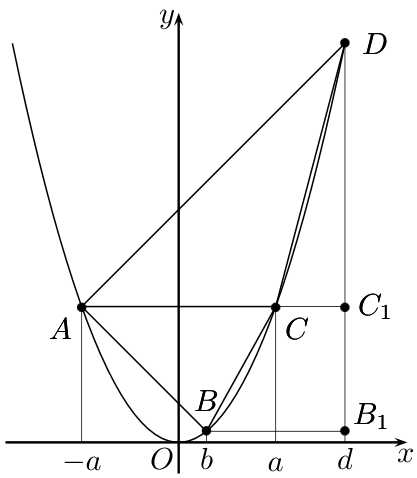
The required area is equal to . The triangles and have common base and the sum of their altitudes equals . Therefore the required area is equal to .
Want a route through all this instead of an archive? The track
puts 2,604 problems in a working order, from Junior Challenge level to the IMO shortlist.