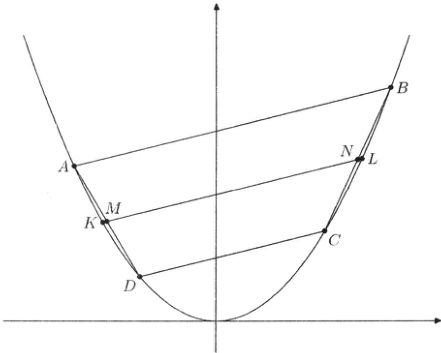
A trapezoid () is inscribed into the parabola . The line containing the midline of this trapezoid meets the parabola at points and .
Prove that the lengths of the segments and are equal.
(I. Gorodnin)
Belarusian Mathematical Olympiad
Solution
Let , , , , , , , . Without loss of generality we can assume that the points are arranged as shown in the figure (all other cases are similar).
It is easy to write the equations of the straight lines , , , ,
Since the lines , , are parallel, their slopes are equal, so
where is some real number.
The point is the intersection point of the lines and , so its abscissae satisfies the equation
Taking into account (1), we obtain
Similarly, the abscissae of the point ( is the intersection point of the lines and ) satisfies the equation
Taking into account (1), we obtain
Subtracting (3) from (2), we get
Since , we have , i.e., . This equality can be written as . It follows that the midpoints of the segments and coincide. Since and lie on the same straight line, we obtain as required.
Want a route through all this instead of an archive? The track
puts 2,604 problems in a working order, from Junior Challenge level to the IMO shortlist.