We color each unit square of a table into green or blue such that there are green unit squares in each square and green unit squares in each rectangle. Find all possible values of ().
Saudi Arabian Mathematical Competitions, 2015
Solution
By tiling our table by eight rectangles like in Tiling (1) we find that the total number of green unit squares in the table is .
By tiling our table by four squares, three rectangles and one square, like in Tiling (2), we find that the total number of green unit squares in the table is , where is the number of green unit squares in the square in the left upper corner. Notice that by just rotating our tiling (2) so that the square occupies at each time the four corners of the table, we deduce that the four unit squares in the four corners, all have the same number of green unit squares .
Finally, by tiling our table by six rectangles and four squares, like in Tiling (3), we find that the total number of green unit squares in the table is
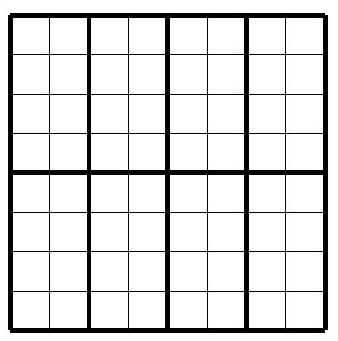
Tiling (1)
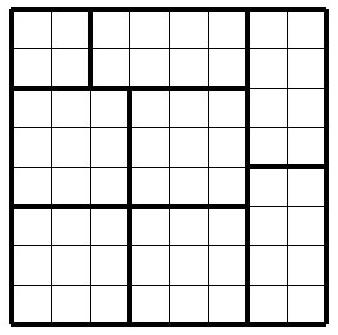
Tiling (2)
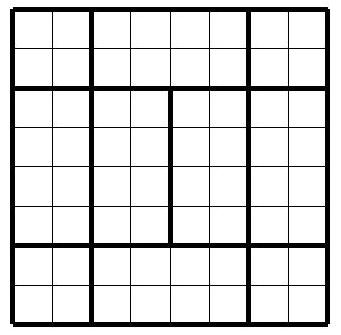
Tiling (3)
Putting together all these totals, we obtain the relations
from which we deduce that and . Since , either and or and . In other words, either we color the whole table or we don't color at all.
Want a route through all this instead of an archive? The track
puts 2,604 problems in a working order, from Junior Challenge level to the IMO shortlist.