Maths Olympiad Prep

Library / /46 of 155

Geometry Difficulty 5.6 AIME, harder Prove it Saudi Arabia

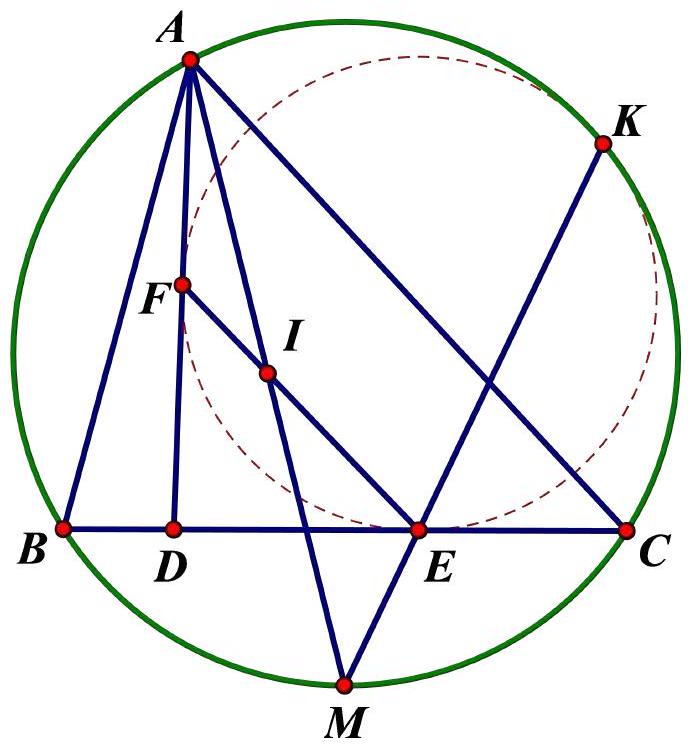
Let ABCABC be a triangle and II its incenter. The point DD is on segment BCBC and the circle ω\omega is tangent to the circumcircle of triangle ABCABC but is also tangent to DCDC, DADA at EE, FF, respectively. Prove that EE, FF and II are collinear.

Solution

Denote ω\omega the circumcircle of ABC\triangle ABC and γ\gamma the circle tangent to ω\omega, DADA, DCDC. Let ω\omega touch γ\gamma at KK and MM be the midpoint of arcBC\operatorname{arc} BC on ω\omega not containing KK. One has the dilation with center KK sending γ\gamma to ω\omega and BCBC to the tangent of ω\omega at MM. Hence KK, EE, MM are collinear. We also have AA, II, MM are collinear and MI=MCMI = MC.

Let EIEI meet γ\gamma again at FF'. Since ω\omega, γ\gamma have the same tangent at KK then KFI=EFK=MAK=KAIAKIF\angle KF'I = \angle EF'K = \angle MAK = \angle KAI \Rightarrow AKIF' is cyclic. One has MCB=MBC=MKCMECMCK\angle MCB = \angle MBC = \angle MKC \Rightarrow \triangle MEC \sim \triangle MCK. Hence
MI2=MC2=MEMKMEIMIK. MI^2 = MC^2 = ME \cdot MK \Rightarrow \triangle MEI \sim \triangle MIK .
Therefore, KEI=AIK=AFK\angle KEI = \angle AIK = \angle AF'K. This implies that AFAF' is tangent to γ\gamma, and F=FF = F'.
Hence EE, II, FF are collinear.
Figure 1 \square

Want a route through all this instead of an archive? The track puts 2,000 problems in a working order, from AMC 10 level to the IMO shortlist.

Source: MathNet, licensed CC-BY-4.0. Statement and solution reproduced as published; topic and difficulty added by this site.