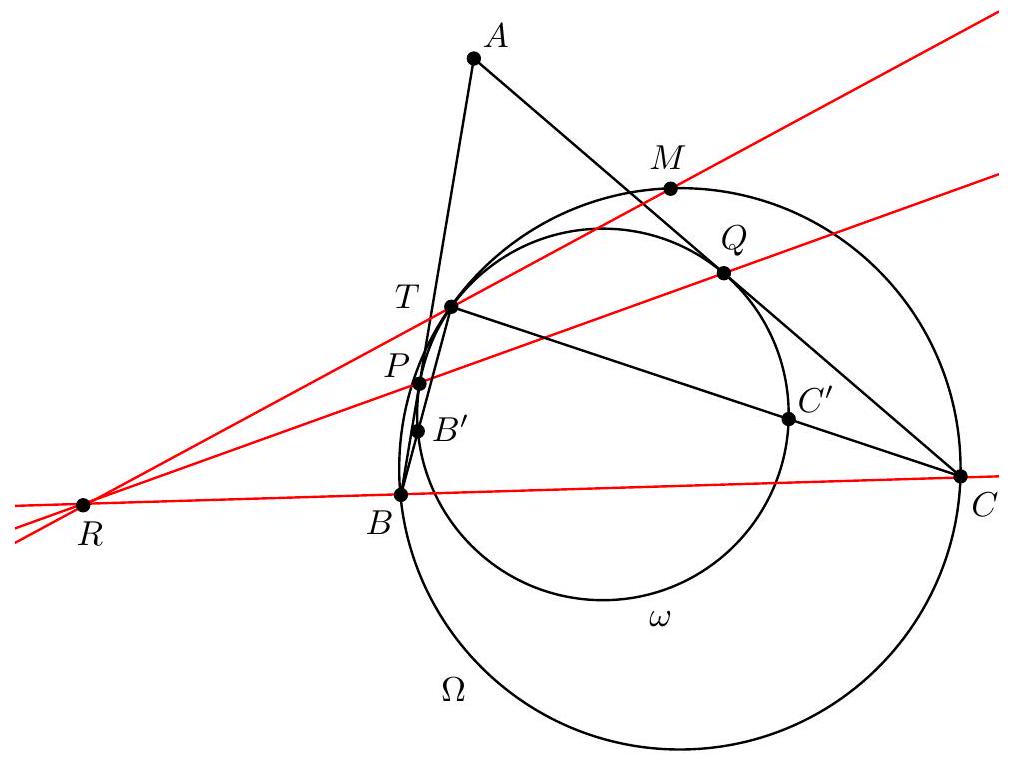
Let ABC be a triangle. Circle Ω passes through points B and C. Circle ω is tangent internally to Ω and also to sides AB and AC at T, P, and Q, respectively. Let M be midpoint of arc BC (containing T) of Ω. Prove that lines PQ, BC, and MT are concurrent.
Solution
Let R be the intersection point of lines PQ and BC, and S the intersection point of lines MT and BC.
Because circle ω is tangent to both sides AB and AC at P and Q, we have AP=AQ. Applying Menelaus' theorem to triangle ABC and line PQ we obtain RCBR=−PABP⋅QCAQ=−QCBP. Because M is the midpoint of arc BC of circle Ω containing T, line MT is the external bisector of angle ∠BTC. We deduce that SCBS=−TCTB To prove that S=R, we have to prove that SCBS=RCBR, which is equivalent to proving that QCBP=TCTB. Let B′ and C′ be the second intersection points of lines TB and TC with circle ω, respectively. Because circles Ω and ω are tangent at T, segments BC and B′C′ are parallel, and therefore TCTB=CC′BB′. Because lines AB and AC are tangent to ω at P and Q, respectively, we have from the power of points B and C with respect to circle ω (CQBP)2=CT⋅CC′BT⋅BB′=(CTBT)2.
Want a route through all this instead of an archive? The track
puts 2,604 problems in a working order, from Junior Challenge level to the IMO shortlist.
Source: MathNet,
licensed CC-BY-4.0.
Statement reproduced verbatim; metadata (topic, difficulty) added by this project.