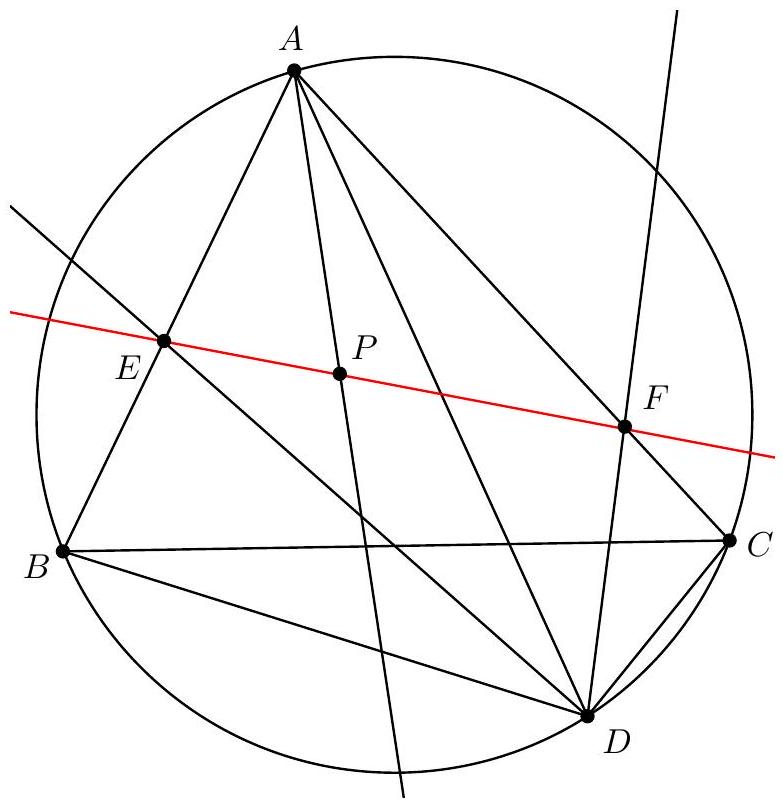
Let ABC be a triangle, I its incenter, and D a point on the arc BC of the circumcircle of ABC not containing A. The bisector of the angle ∠ADB intersects the segment AB at E. The bisector of the angle ∠CDA intersects the segment AC at F. Prove that the points E, F, I are collinear.
Solution
First solution. Let P be the intersection point of the bisector of the angle ∠BAC with the segment EF. Because both I and P are on the bisector of ∠BAC, the problem is equivalent to showing that AP=AI. Because DE is the bisector of ∠ADB we have from the bisector theorem ADAE=BDBE=AD+BDAB Because DF is the bisector of ∠CDA we have from the bisector theorem ADAF=CDCF=AD+CDAC. We deduce that AE1+AF1=AB⋅AC⋅ADAD⋅AC+BD⋅AC+AD⋅AB+CD⋅AB=AB⋅AC⋅ADAD⋅AC+AD⋅AB+AD⋅BC=AB⋅ACAB+BC+CA from Ptolemy's theorem applied to the cyclic quadrilateral ABDC. Now from the areas of triangles AEP, APF and AEF, we have 21AE⋅APsin2α+21AF⋅APsin2α=21AE⋅AFsinα, from which we deduce AP=AE+AF2AE⋅AFcos2α=AB+BC+CA2AB⋅ACcos2α=sAB⋅ACcos2α=s⋅BC4RΔcos2α=sinα2rcos2α=sin2αr=AI,
Saudi Arabia Mathematical Competitions 2015 where α=∠BAC, s=2AB+BC+CA is the semi-perimeter of triangle ABC, R its circumradius, r its inradius and Δ=4RAB⋅BC⋅CA=rs its area.
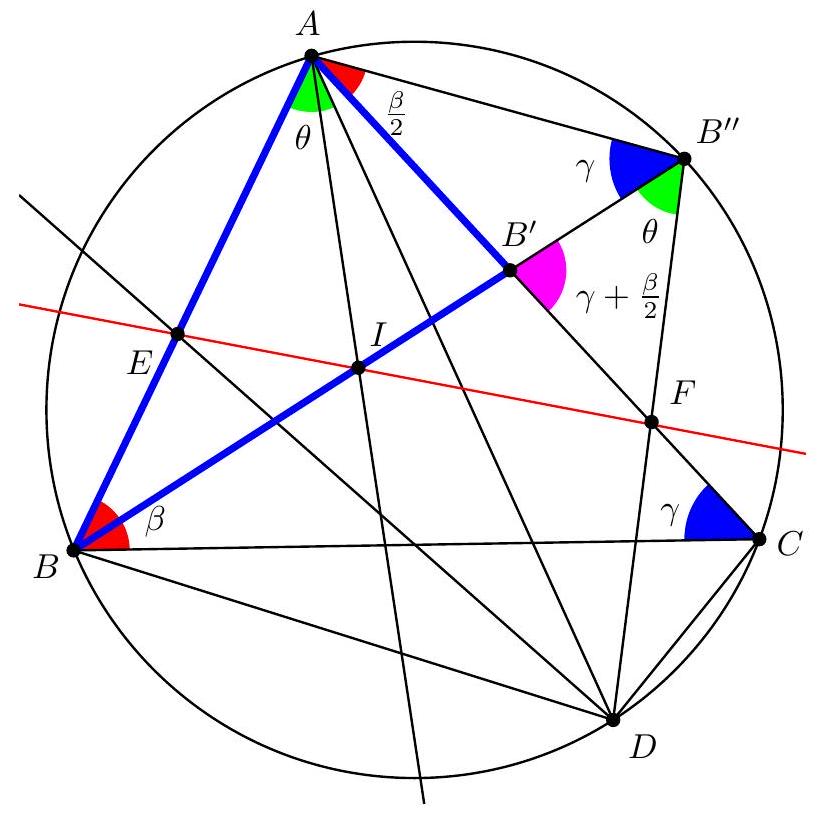
Second Solution. Let B′ and B′′ be the intersection points of the bisector of the angle ∠CBA with the side BC and the arc BC. Denote β=∠CBA, γ=∠ACB and θ=∠BAD. We have ∠B′B′′F=∠BB′′D=∠BAD=θ and ∠FB′B′′=∠CAB′′+∠AB′′B=∠CBB′′+∠ACB=2β+γ. We deduce from sine law in triangle B′FB′′ that FB′′B′F=sin(2β+γ)sinθ We have ∠AB′′F=∠AB′′B+∠BB′′D=∠ACB+∠BAD=γ+θ and ∠FAB′′=∠CAB′′=∠CBB′′=2β. We deduce from sine law in triangle AFB′′ that FB′′FA=sin2βsin(γ+θ)
We deduce that FAB′F=−sin(2β+γ)sin(γ+θ)sinθsin2β Because DE is the bisector of angle ∠ADB, we have from the theorem of bisectors EBAE=DBAD=sin∠DABsin∠ABB′′D=sinθsin(γ+θ). Because AI is the bisector of angle ∠BAB′, we have from the theorem of bisectors and sine law in triangle ABB′ IB′BI=AB′AB=sin∠B′BAsin∠ABB′B=sin2βsin(2β+γ).
Therefore EBAE⋅IB′BI⋅FAB′F=−1 and from the theorem of Menelaus applied to the triangle ABB′, the points E, I, F are collinear.
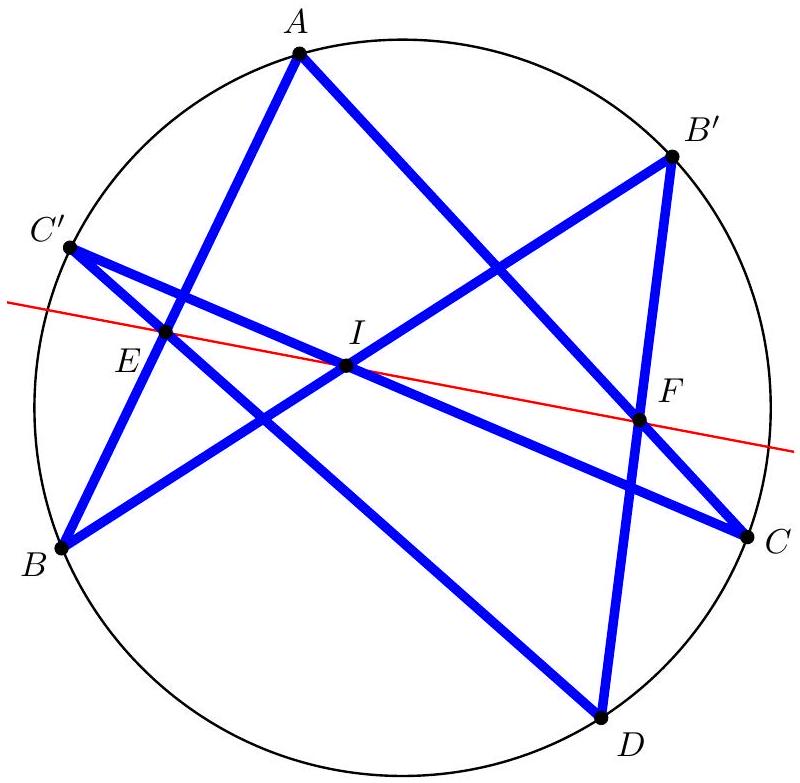
Third Solution. Let B′ and C′ be the midpoints of the arcsCA and AB, respectively. Because DB′ and DC′ are the bisectors of the angles ∠ADB and ∠CDA, respectively, point E is the intersection of AB and DC′, point I is the intersection of BB′ and C′C, and point F is the intersection of B′D and CA. We deduce from Pascal's theorem applied to the cyclic hexagon ABB′DC′C that the three points E, I and F are collinear.
Want a route through all this instead of an archive? The track
puts 2,604 problems in a working order, from Junior Challenge level to the IMO shortlist.
Source: MathNet,
licensed CC-BY-4.0.
Statement reproduced verbatim; metadata (topic, difficulty) added by this project.