Solution 1. Because the arcs AB and CD, as well as BC and DE are equal, the cyclic quadrilaterals ABCD and BCDE are isosceles trapeziums with BC∥AD and CD∥BE. Hence, BFDC is a parallelogram. As a consequence we see that ∣BF∣=∣CD∣=∣BA∣ and so △AFB is isosceles.
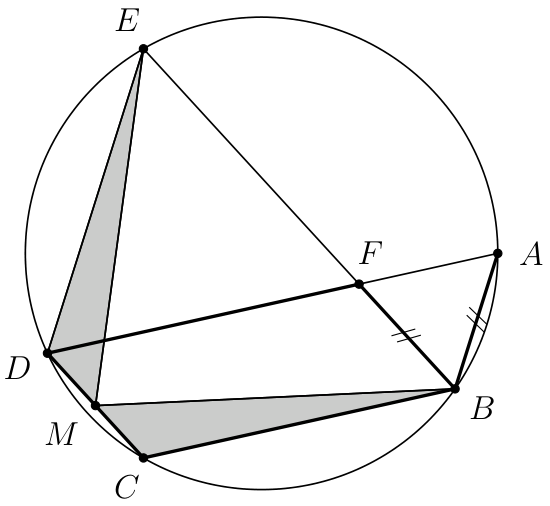
Triangles △EDM and △BCM are congruent by SAS, since ∣ED∣=∣BC∣, ∠EDC=∠DCB in isosceles trapezium, and ∣DM∣=21∣CD∣=∣CM∣. Hence ∣EM∣=∣MB∣.
To complete the solution, we prove that ∣MB∣=∣MN∣, where N is the midpoint of AF. Here are three ways doing so.
First way: Let P be the midpoint of AB. Since M, P, N are midpoints, PN∥BF∥CD and ∣CM∣=21∣CD∣=21∣BF∣=∣NP∣. This implies that CPNM is a parallelogram, in particular ∣MN∣=∣CP∣.
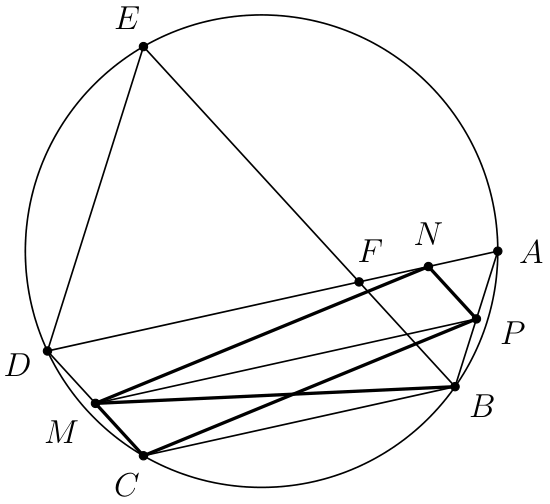
On the other hand, triangles △CBP and △BCM are congruent by SAS: BC common, ∠C=∠B in isosceles trapezium, and ∣CM∣=21∣CD∣=21∣AB∣=∣BP∣. This implies ∣MB∣=∣CP∣=∣MN∣.
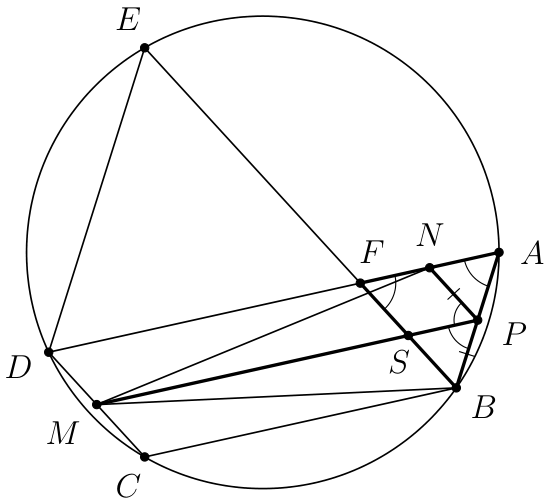
Because PM is the mid-line of the trapezium ABCD, PM∥AD and so ∠FAB=∠MPB and PNFS is a parallelogram where S is the intersection point of PM and EB. Hence,
∠MPN=∠AFB=∠FAB=∠MPB
where we have used again that △AFB is isosceles. We now conclude that triangles △MPN and △MPB are congruent by SAS: MP common, ∠MPB=∠MPN and ∣PN∣=∣BP∣ as shown above. This implies ∣MN∣=∣MB∣.
Third way: As △BAF is isosceles and AD∥BC, we have BN⊥AF and BN⊥BC. Extend the line NM to meet line BC at Q.
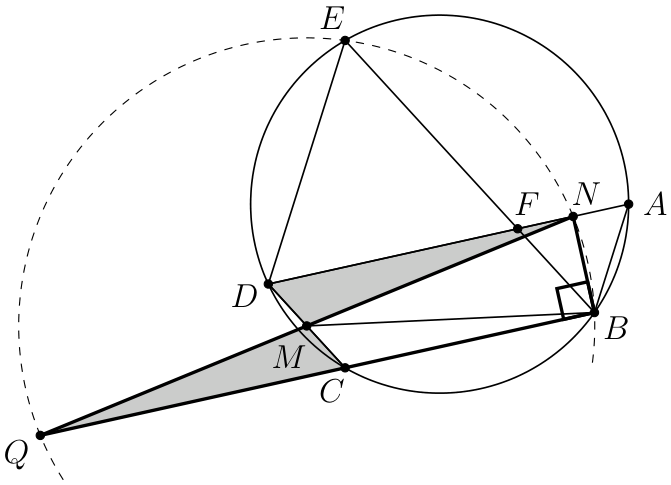
Since DN∥CQ and M is midpoint of CD, we get △MDN≅△MCQ (ASA) and hence M is the midpoint of NQ in the right angled triangle QBN. This implies ∣MN∣=∣MQ∣=∣MB∣.
Solution 2
Let N denote the midpoint of AF. We have ∠ECD=∠EAF since both are standing on the arc DE. Since the arcs AB and CD are equal, we also have ∠DEC=∠FEA. This shows that △EDC and △EFA are similar.
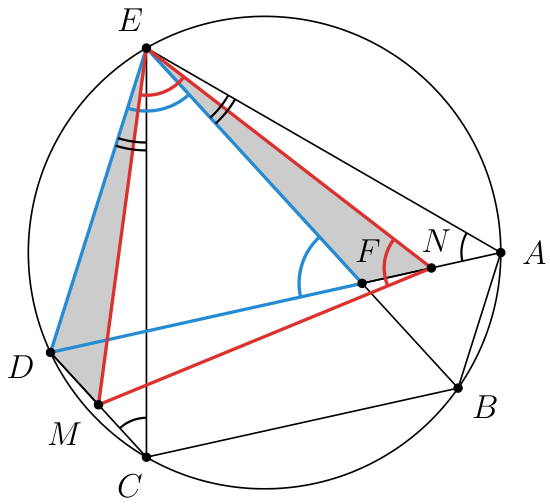
As a consequence, we have ∣EF∣∣ED∣=∣AF∣∣CD∣. Because M and N are the midpoints of CD and AF, we now get ∣EF∣∣ED∣=∣NF∣∣MD∣, which implies △EDM∼△EFN since ∠EDM=∠EDC=∠EFA=∠EFN. Hence ∣EF∣∣ED∣=∣EN∣∣EM∣. From ∠DEM=∠FEN we obtain ∠DEF=∠MEN, hence △EDF is similar to △EMN.
We have seen above that ∠FEA=∠DEC, and we also have ∠EAF=∠CEB because the arcs on which they are standing, DE and BC, are equal. Therefore, ∠EFD=∠FEA+∠EAF=∠DEC+∠CEB=∠DEF. This means that △EDF is isosceles with ∣ED∣=∣DF∣ and so △EMN is isosceles with ∣EM∣=∣MN∣ as well.