Maths Olympiad Prep

Library / /16 of 34

, 2010

Geometry Difficulty 5.7 AIME, harder Prove it Austria

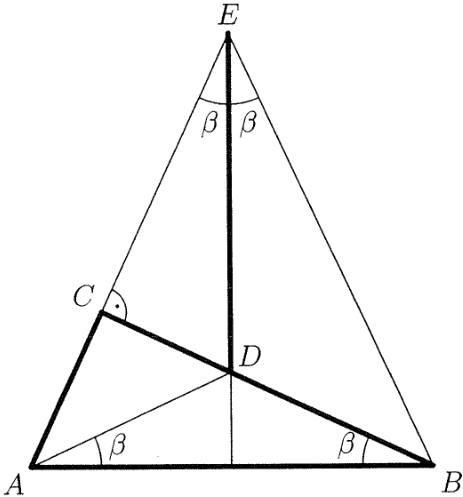
Let ABCABC be a right-angled triangle with the right angle at CC such that the side BCBC is longer than the side ACAC. The perpendicular bisector of ABAB intersects the line BCBC in DD and the line ACAC in EE. We assume that DEDE and the side ABAB have the same length.

Determine the angles of the triangle ABCABC.

Solution

The angle ABC\angle ABC is denoted by β\beta. As BCBC is normal to AEAE and DEDE is normal to
Figure 1
Abbildung 1: Problem 4.
ABAB, the angles ABC\angle ABC and AED\angle AED are of equal measure. As we have ACB=DCE=90\angle ACB = \angle DCE = 90^\circ and, by assumption, AB=DE\overline{AB} = \overline{DE}, the triangles ABCABC and DECDEC are congruent.

This yields BC=CE\overline{BC} = \overline{CE} which implies that the triangle BCEBCE is an isosceles right-angled triangle with CEB=CBE=45\angle CEB = \angle CBE = 45^\circ.

Furthermore, we have β=CED=DEB\beta = \angle CED = \angle DEB, as EE lies on the perpendicular bisector of ABAB.

Thus we obtain 45=CEB=2β45^\circ = \angle CEB = 2\beta and therefore β=22.5\beta = 22.5^\circ and α=CAB=67.5\alpha = \angle CAB = 67.5^\circ.

Want a route through all this instead of an archive? The track puts 2,000 problems in a working order, from AMC 10 level to the IMO shortlist.

Source: MathNet, licensed CC-BY-4.0. Statement and solution reproduced as published; topic and difficulty added by this site.