Olympiad Maths Prep

Library / /4 of 5

Geometry Difficulty 5.8 AIME, harder Prove it Greece

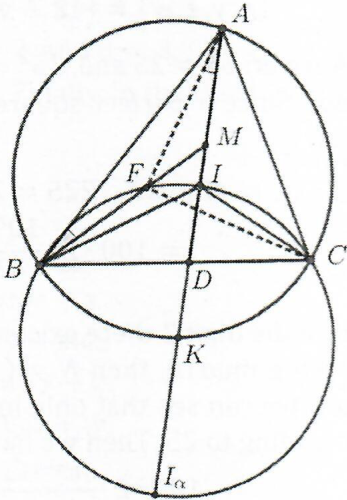
Let ABCABC be a triangle with AB>ACAB > AC, ADAD its bisector, where DD is a point on the side BCBC and II its incenter. If MM is the midpoint of the segment ADAD and FF is the point of intersection of the line MBMB with the circumcircle of the triangle BICBIC, prove that: AFFCAF \perp FC.
(E. Psarras)

Solution

Since CIIa=BIIa=90\angle CII_a = \angle BII_a = 90^\circ the excenter IaI_a belongs to the circumcircle of the triangle BICBIC. Moreover in the triangle CDACDA, CI,CIaCI, CI_a are the internal and external bisector, respectively, and therefore the points A,DA, D are the conjugate harmonics of the points I,IaI, I_a. Since MM is the midpoint of the segment ADAD, from the relation of Newton we have:
MA2=MIMIa.(1) MA^2 = MI \cdot MI_a. \qquad (1)
Taking the power of MM with respect to the circle (I,B,C)(I, B, C) we have:
MIMIa=MFMB.(2) MI \cdot MI_a = MF \cdot MB. \qquad (2)
From (1) and (2) it follows that:
MA2=MFMB, MA^2 = MF \cdot MB,
Which means that MAMA is tangent of the circumcircle of the triangle AFBAFB. Therefore
MBA=FAM.(3) \angle MBA = \angle FAM. \qquad (3)
and finally
FAC+FCA=FAM+A2+FCI+C2=(3)MBA+A2+FBI+C2=A2+B2+C2=90. \begin{align*} \angle FAC + \angle FCA &= \angle FAM + \frac{\angle A}{2} + \angle FCI + \frac{\angle C}{2} = \\ & (3) \qquad \angle MBA + \frac{\angle A}{2} + \angle FBI + \frac{\angle C}{2} = \frac{\angle A}{2} + \frac{\angle B}{2} + \frac{\angle C}{2} = 90^\circ. \end{align*}
Hence: AFFCAF \perp FC.

Figure 1
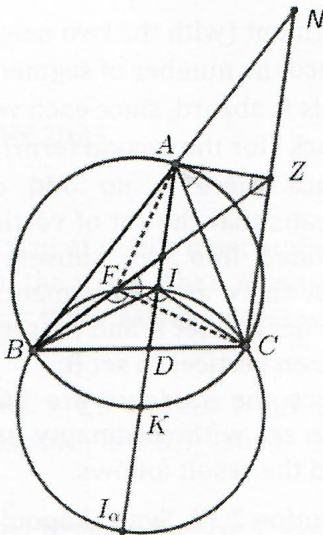
Figure 2

We draw from CC the parallel line to the bisector ADAD which meets the line ABAB at point NN and the line AMAM at point ZZ. Taking angle equalities we have:
ACN=DAC=A2,ANC=BAD=A2 \angle ACN = \angle DAC = \frac{\angle A}{2}, \quad \angle ANC = \angle BAD = \frac{\angle A}{2}
And so the triangle ACNACN is isosceles. Since MM is the midpoint of ADAD it follows that ZZ is the midpoint of CNCN. Hence AZCNAZC=90AZ \perp CN \Rightarrow \angle AZC = 90^\circ.
Therefore, in order to have AFC=90\angle AFC = 90^\circ, it is enough to prove that the quadrilateral CFAZCFAZ is cyclic. In fact, we have
CFZ=180BFC=180BIC=180(90+A2)=90A2=CAZ. \angle CFZ = 180^\circ - \angle BFC = 180^\circ - \angle BIC \\ = 180^\circ - \left(90^\circ + \frac{\angle A}{2}\right) = 90^\circ - \frac{\angle A}{2} = \angle CAZ.

Figure 2
Figure 3

Looking for a route rather than an archive? The track puts 2,000 problems in a working order, from AMC 10 level to the IMO shortlist.

Source: MathNet, licensed CC-BY-4.0. Statement and solution reproduced as published; topic and difficulty added by this site.