First, we prove that n≥11. Suppose a convex heptagon has its vertices in M given by A1A2A3A4A5A6A7. Using Condition (1), we get that there exists one point P1 belonging to M in the interior of convex pentagon A1A2A3A4A5. Connecting P1A1 and P1A5, we obtain that there exists one point P2 in convex pentagon A1P1A5A6A7 so that P2 belongs to M and is different from P1. Then, there are at least 5 points in {A1,A2,A3,A4,A5,A6,A7} which do not lie on line P1P2. By the Pigeon Hole Principle, there exist at least 3 points on one side of line P1P2, and these 3 points together with P1 and P2 constitute a convex pentagon which contains at least one point P3 belonging to M.
Now, we have three lines P1P2, P2P3 and P3P1, which form a triangle △P1P2P3. Let π1 denote the half-plane on one side of line P1P2 which is opposite to △P1P2P3 and contains no points on P1P2. In a similar way, we define π2 and π3. Areas π1, π2 and π3 cover the entire plane except △P1P2P3. By the Pigeon Hole Principle, there is one area of π1, π2 and π3 which contains at least 3 points belonging to {A1,A2,A3,A4,A5,A6,A7}, Without loss of generality, we assume that the area π1 contains points A1,A2,A3, then there exists one point P4 belonging to M within the convex pentagon constituted by A1,A2,A3,P1 and P2. So, n≥11.
Now, we give an example to illustrate that n=11 is attainable. As seen in the figure, set M consists of integral points A1,A2,A3,A4,A5,A6,A7, and four integral points within the heptagon A1A2A3A4A5A6A7. Obviously, M satisfies Condition (1). We are going to
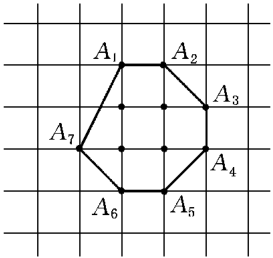
prove that M also satisfies Condition (2).
By reduction to absurdity, assume that there is a convex pentagon with its vertices belonging to M which contains no point of M in its interior. Then among such pentagons there must be one, denoted by ABCDE, which has the least area, since the value of the area of a polygon with integral vertices is always in the form of 2n (n∈N).
There are only 4 cases concerning the odd/even property of the xy-coordinate of an integral point: (odd, even), (even, odd), (odd, odd), (even, even). So there must be two vertices among A,B,C,D,E which have the same odd/even property, and the midpoint of the segment formed by these two vertices, say P, is also an integral point and belongs to M. By definition, P is not in the interior of pentagon ABCDE, then it must be on one side of the pentagon. Assume that P is on the side AB, then it must be the midpoint of AB, and PBCDE is a convex pentagon with strictly less area than that of ABCDE.
So, the minimum value of n is 11.