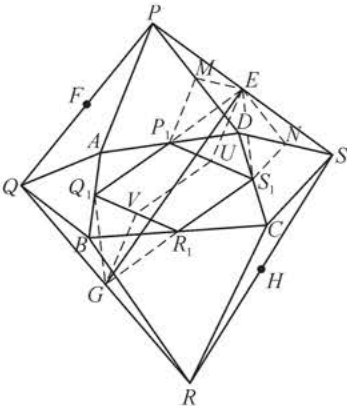
Outside a convex quadrilateral ABCD we construct equilateral triangles ABQ, BCR, CDS and DAP. Denoting by x the sum of the diagonals of ABCD, and by y the sum of line segments joining the midpoints of opposite sides of PQRS, we find the maximum value of xy.
Solution
If ABCD is a square, then xy=21+3.
Now we prove that xy≤21+3.
Denote by P1,Q1,R1,S1 the midpoints of DA, AB, BC, CD, and by E, F, G, H the midpoints of SP, PQ, QR, RS. Then P1Q1R1S1 is a parallelogram.
Now draw lines P1E, S1E, and denote by M, N the midpoints of DP, DS. Then DS1DP1=S1N=DN=EM,=P1M=MD=EN, and ∠P1DS1=360∘−60∘−60∘−∠PDS=240∘−(180∘−∠END)=60∘+∠END=∠ENS1=∠EMP1. So we have △DP1S1≅△MP1E≅△NES1. Hence, △EP1S1 is equilateral.
By the same argument, △GQ1R1 is also equilateral. Now let U, V be the midpoints of P1S1, Q1R1, respectively. We then obtain EG≤EU+UV+VG=23P1S1+P1Q1+23Q1R1=P1Q1+3P1S1=21BD+23AC, and also FH≤21AC+23BD.
Taking the sum of these two inequalities, we have y≤21+3x, i.e. xy≤21+3.
Want a route through all this instead of an archive? The track
puts 2,604 problems in a working order, from Junior Challenge level to the IMO shortlist.
Source: MathNet,
licensed CC-BY-4.0.
Statement reproduced verbatim; metadata (topic, difficulty) added by this project.