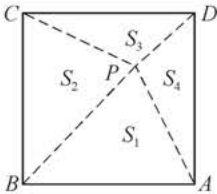
Find the smallest constant a>1, such that for any point P inside a square ABCD there exist two triangles among △PAB, △PBC, △PCD, △PDA, with the ratio between their areas belonging to the interval [a−1,a]. (Posed by Li Weigu)
Solution
amin=21+5.
Write φ=21+5. We may assume that each edge has length 2. For any point P inside the square ABCD, let S1,S2,S3,S4 denote the area of △PAB, △PBC, △PCD, △PDA respectively; we can also assume that S1≥S2≥S3≥S4.
Let λ=S2S1, μ=S4S2. If λ,μ>φ, as S1+S3=S2+S4=1, we have 1−S2S2=μ, S2=1+μμ. So S1=λS2=1+μλμ=1+μ1λ>1+φ1φ=1+φφ2=1, and we reach a contradiction. Hence, min{λ,μ}≤φ, which implies that amin≤φ.
On the other hand, for any a∈(1,φ), we take any t∈(a,21+5) such that b=1+tt2>98. Inside the square ABCD we can choose a point P so that S1=b, S2=tb, S3=t2b, S4=1−b. Then we have S2S1=S3S2=t∈(a,21+5), S4S3=t2(1−b)b>4(1−b)b>2>a. Thus, for any i,j∈{1,2,3,4}, we have SjSi∈/[a−1,a].
Hence amin=φ.
Want a route through all this instead of an archive? The track
puts 2,604 problems in a working order, from Junior Challenge level to the IMO shortlist.
Source: MathNet,
licensed CC-BY-4.0.
Statement reproduced verbatim; metadata (topic, difficulty) added by this project.