Maths Olympiad Prep

Library / Estonian Mathematical Olympiad /33 of 93

Estonian Mathematical Olympiad

Geometry Difficulty 5.8 AIME, harder Prove it Estonia

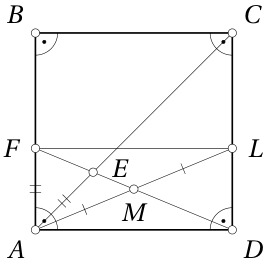
Let ABCDABCD be a rectangle. The bisector of the angle CADCAD meets the side CDCD at point LL. Let MM be the midpoint of the line segment ALAL. The line DMDM meets lines ACAC and ABAB at points EE and FF, respectively. Given that line segments AEAE and AFAF are equal, prove that ABCDABCD is a square.

Solutions — 2

Solution 1

Let ∠DAL=∠LAC=α\angle DAL = \angle LAC = \alpha. Then ∠FAE=90∘−2α\angle FAE = 90^\circ - 2\alpha (Fig. 1).

As AE=AFAE = AF, we obtain ∠AFE=180∘−(90∘−2α)2=45∘+α\angle AFE = \frac{180^\circ - (90^\circ - 2\alpha)}{2} = 45^\circ + \alpha.

But as MM bisects the hypotenuse ALAL of the right triangle ALDALD, it follows that MM is the circumcentre of ALDALD, implying MA=MDMA = MD. Hence ∠MDA=∠MAD=α\angle MDA = \angle MAD = \alpha, implying ∠AFE=∠AFD=90∘−α\angle AFE = \angle AFD = 90^\circ - \alpha.

We obtain 45∘+α=90∘−α45^\circ + \alpha = 90^\circ - \alpha which implies ∠CAD=2α=45∘\angle CAD = 2\alpha = 45^\circ. Hence also ∠ACD=45∘\angle ACD = 45^\circ, implying AD=CDAD = CD. Consequently, ABCDABCD is a square.

Figure 1
Fig. 1

Solution 2

As AE=AFAE = AF, the triangle AEFAEF is isosceles with vertex angle at AA (Fig. 1). Denote ∠AEF=∠AFE=β\angle AEF = \angle AFE = \beta.

Note that triangles MAFMAF and MLDMLD are equal because ∠FMA=∠DML\angle FMA = \angle DML, ∠MAF=∠MLD\angle MAF = \angle MLD and MA=MLMA = ML. Thus AF=DLAF = DL which shows that ADLFADLF is a rectangle. As the diagonals of a rectangle are equal and bisect each other, we have MA=MFMA = MF, implying that the triangle MAFMAF is isosceles with vertex angle at MM. Hence ∠MAF=∠MFA=β\angle MAF = \angle MFA = \beta.

As ∠EAF=180∘−2β\angle EAF = 180^\circ - 2\beta, we have ∠MAE=β−(180∘−2β)=3β−180∘\angle MAE = \beta - (180^\circ - 2\beta) = 3\beta - 180^\circ. Hence also ∠MAD=3β−180∘\angle MAD = 3\beta - 180^\circ, because AMAM bisects the angle DAEDAE. We obtain the equation β+(3β−180∘)=90∘\beta + (3\beta - 180^\circ) = 90^\circ which gives β=67.5∘\beta = 67.5^\circ. Thus ∠BAC=180∘−2⋅67.5∘=45∘\angle BAC = 180^\circ - 2 \cdot 67.5^\circ = 45^\circ, implying that the diagonal of the rectangle ABCDABCD bisects its angle. Consequently, ABCDABCD is a square.

Figure 1
Fig. 1

Want a route through all this instead of an archive? The track puts 2,604 problems in a working order, from Junior Challenge level to the IMO shortlist.

Source: MathNet, licensed CC-BY-4.0. Statement reproduced verbatim; metadata (topic, difficulty) added by this project.