Let , , , and be consecutive points on a circle with the centre at , such that . Let , and be the orthocentres of the triangles , and . Prove that is a right triangle.
Slovenian Mathematical Olympiad, 2008
Solutions — 3
Solution 1
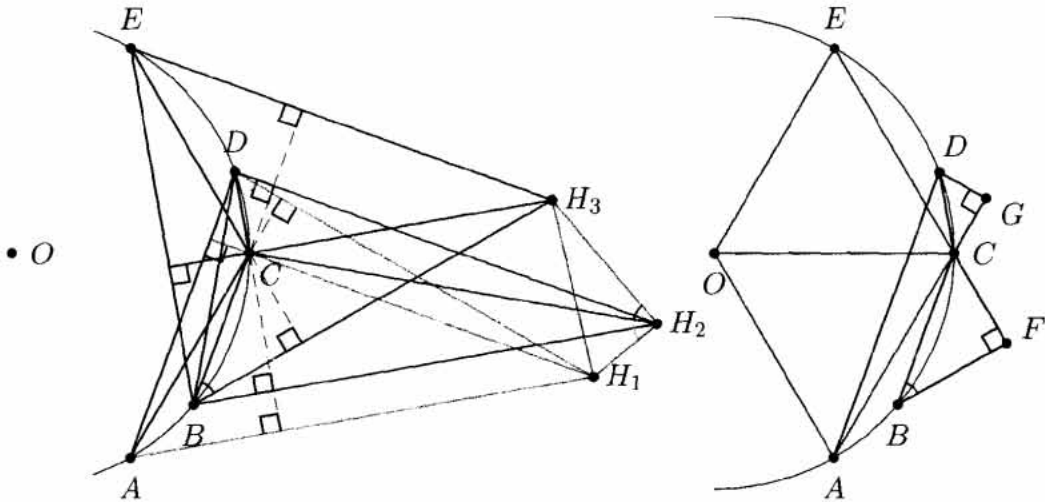
This problem has several interesting solutions. A nicely drawn figure suggests that quadrilaterals and are parallelograms. We will prove this fact.
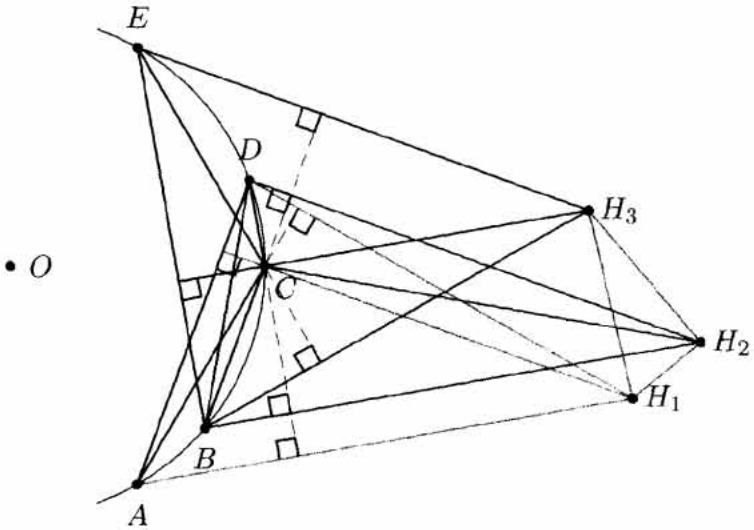
Triangles , and are obtuse, so let us first make a short detour examining some properties of obtuse triangles. Let be a triangle with the obtuse angle and let be the orthocentre. The point lies outside the triangle and on a different side of the line than . Let and be the feet of the altitudes from and . Since , points , , , are concyclic and .
The following fact is also worth mentioning: since is a right triangle the angle is acute. Points , , , are concyclic, so , and the angle is obtuse.
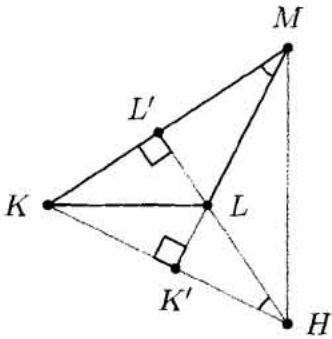
Let us now return to the original problem. Here to help us are the facts stated above and a new and less cluttered figure.
Since , the inscribed angles over these two chords are equal, so , which implies , so and are parallel and is an isosceles trapezoid.
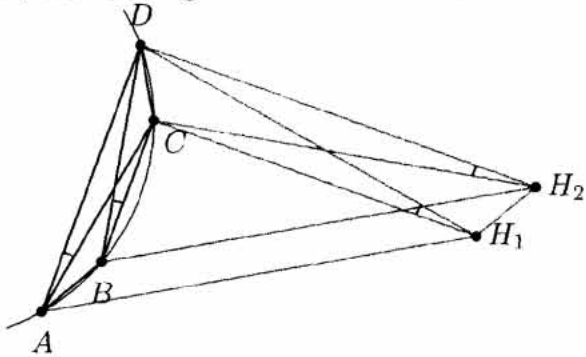
Points , , and are concyclic, so . From the above consideration we see that and ,
so and points , , , are concyclic. But is perpendicular to , is perpendicular to and lines and are parallel, so and are parallel as well. The cyclic quadrilateral has a pair of parallel sides and and is therefore an isosceles trapezoid.
We have seen that and are isosceles trapezoids, so we have . The altitude is perpendicular to the side and so is the altitude , hence and are parallel. The quadrilateral has a pair of parallel sides ( and ) and a pair of sides of equal length ( and ). Thus, it is either an isosceles trapezoid or a parallelogram. Let us demonstrate that it is, in fact, the latter.
Lines and are parallel, so the point lies on the side of the line not containing . As we have shown above the angle is obtuse, so the angle , which is equal to , is also obtuse. But , so the angle is obtuse. On the other hand, the angle is acute, so is acute as well (points and lie on the same side of the line , because neither of them lies on the same side as ). We have shown that is acute and is obtuse, so the quadrilateral is a parallelogram. Hence, is parallel to .
Similarly, we show that is parallel to . If we wish to prove that , it suffices to see that lines and intersect at a right angle.
Denote the intersection of and by . Since and , we have . So and this concludes our proof.
Solution 2
Since , points , , , are concyclic. Similarly, we show that the quadrilateral is cyclic.
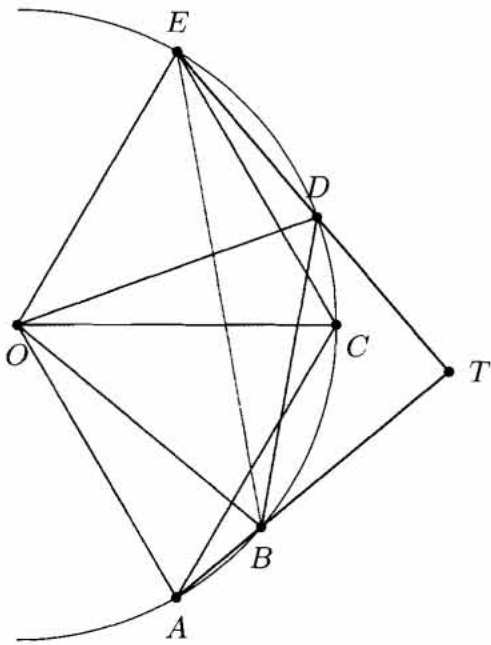
We wish to see that . But so and . Let be the intersection of lines and and let be the intersection of and . We wish to show that .
We will not need the orthocentres this time, so let us draw another figure. Denote and . We have to show that . We have and . So, . In particular, , because the quadrilateral is an isosceles trapezoid, which implies , so and is a right triangle.
Solution 3
Let the system of coordinates be centred at the circumcentre . Since is the orthocentre of the triangle we have . Similarly,
So, and .
The inner product of these two vectors is
Here, we used the fact that is the centre of the circle containing points , , and . Triangles and are equilateral, so . The triangle is also equilateral, so . Thus,
Verify that , which implies
so and . Hence is a right triangle.
Want a route through all this instead of an archive? The track
puts 2,604 problems in a working order, from Junior Challenge level to the IMO shortlist.