Maths Olympiad Prep

Library / /74 of 120

Geometry Difficulty 5.5 AIME, harder Prove it Saudi Arabia

Let PP be a point in the interior of triangle ABCA B C. Lines AP,BP,CPA P, B P, C P intersect sides BC,CA,ABB C, C A, A B at L,M,NL, M, N, respectively. Prove that
APBPCP8PLPMPN. A P \cdot B P \cdot C P \geq 8 P L \cdot P M \cdot P N .

Solutions — 2

Solution 1

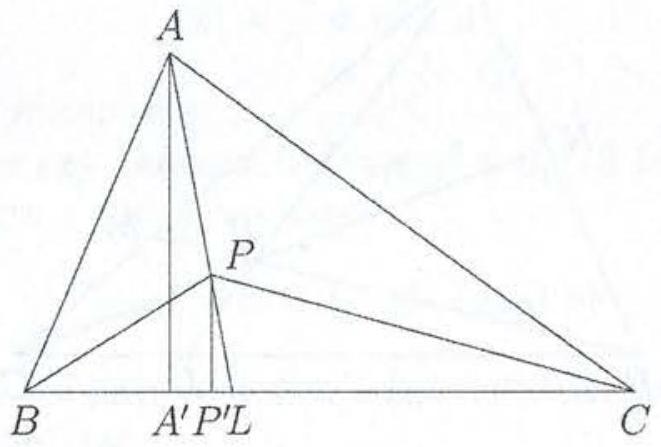
Let KA,KB,KCK_{A}, K_{B}, K_{C} be the areas of triangle BPCB P C, CPAC P A, APBA P B, respectively. Let AA' and PP' be the projections of AA and PP on side BCB C. Triangles ALAA L A' and PLPP L P' are similar, hence we have
ALPL=AAPP=AABCPPBC=KKA,(1) \frac{A L}{P L}=\frac{A A'}{P P'}=\frac{A A' \cdot B C}{P P' \cdot B C}=\frac{K}{K_{A}}, \tag{1}
where KK is area of triangle ABCA B C. From (1) we get
APPL=KB+KCKA \frac{A P}{P L}=\frac{K_{B}+K_{C}}{K_{A}}
Figure 1
In analogous way we obtain
BPPM=KC+KAKB,CPPN=KA+KBKC.(2) \frac{B P}{P M}=\frac{K_{C}+K_{A}}{K_{B}}, \quad \frac{C P}{P N}=\frac{K_{A}+K_{B}}{K_{C}} . \tag{2}
The inequality is equivalent to
APPLBPPMCPPN8 \frac{A P}{P L} \cdot \frac{B P}{P M} \cdot \frac{C P}{P N} \geq 8
that is
(KA+KB)(KB+KC)(KC+KA)8KAKBKC.(3) \left(K_{A}+K_{B}\right)\left(K_{B}+K_{C}\right)\left(K_{C}+K_{A}\right) \geq 8 K_{A} K_{B} K_{C} . \tag{3}
Inequality (3) follows by applying three times the inequality x+y2xyx+y \geq 2 \sqrt{x y}, where x,y>0x, y>0.

Figure 1

We have equality if and only if KA=KB=KC=13KK_{A}=K_{B}=K_{C}=\frac{1}{3} K, hence if and only if P=GP=G, the centroid of triangle ABCA B C.

Solution 2

We will use so-called Van Aubel relation, that is
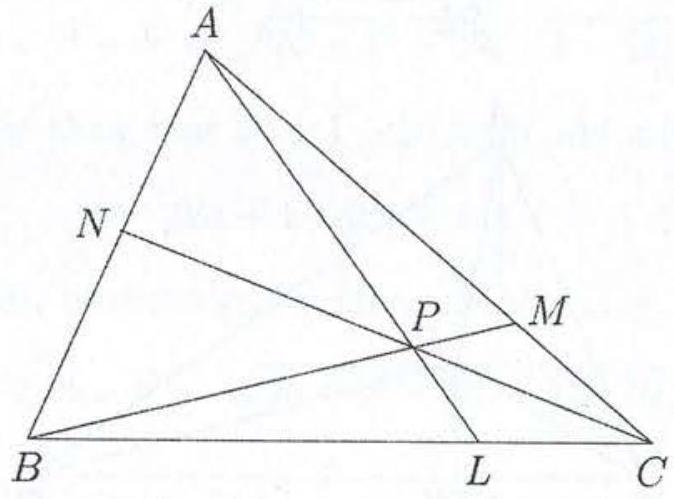
APPL=ANNB+AMMC.(1) \frac{A P}{P L}=\frac{A N}{N B}+\frac{A M}{M C} . \tag{1}
Figure 2
In order to prove (1), we use Menelaos Theorem for triangle ABLA B L and collinear points C,P,NC, P, N, and for triangle ACLA C L and collinear points B,P,MB, P, M. We get
CLCBNBNAPAPL=1 and BLBCMCMAPAPL=1.(2) \frac{C L}{C B} \cdot \frac{N B}{N A} \cdot \frac{P A}{P L}=1 \text{ and } \frac{B L}{B C} \cdot \frac{M C}{M A} \cdot \frac{P A}{P L}=1 . \tag{2}
From (2) we obtain
CLCBAPPL+BLBCAPPL=ANNB+AMMC, \frac{C L}{C B} \cdot \frac{A P}{P L}+\frac{B L}{B C} \cdot \frac{A P}{P L}=\frac{A N}{N B}+\frac{A M}{M C},
hence relation (1) since CL+BL=BCC L+B L=B C.
Writing the similar relations to (1) for Cevians BMB M and CNC N, we have
BPPM=BLLC+BNNA and CPPN=CLLB+CMMA.(3) \frac{B P}{P M}=\frac{B L}{L C}+\frac{B N}{N A} \text{ and } \frac{C P}{P N}=\frac{C L}{L B}+\frac{C M}{M A} . \tag{3}
It follows
APPLBPPMCPPN=(ANNB+AMMC)(BLLC+BNNA)(CLLB+CMMA) \frac{A P}{P L} \cdot \frac{B P}{P M} \cdot \frac{C P}{P N}=\left(\frac{A N}{N B}+\frac{A M}{M C}\right)\left(\frac{B L}{L C}+\frac{B N}{N A}\right)\left(\frac{C L}{L B}+\frac{C M}{M A}\right)
and the inequality follows from AM-GM inequality for two numbers.

Want a route through all this instead of an archive? The track puts 2,000 problems in a working order, from AMC 10 level to the IMO shortlist.

Source: MathNet, licensed CC-BY-4.0. Statement and solution reproduced as published; topic and difficulty added by this site.