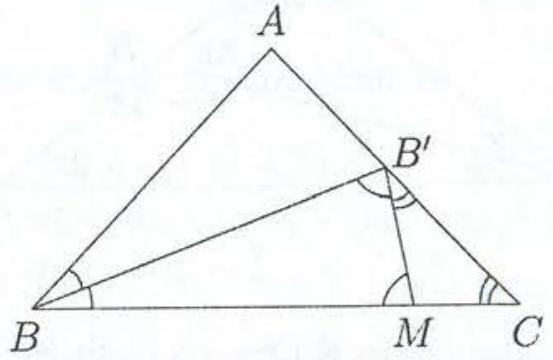
In the isosceles triangle ABC, with AB=AC, the angle bisector of B intersects side AC at B′. Suppose that BB′+B′A=BC. Find the angles of the triangle.
Solutions — 2
Solution 1
On the side BC take point M such that CM=AB′. The angle bisector theorem implies B′CAB′=BCAB=BCAC, hence B′CMC=BCAC. It follows ACMC=BCB′C, that is △MCB′∼△ACB, and we get MC=MB′. Moreover, C=MCB′=MB′C and MC=MB′. From BB′+B′A=BC it follows BB′=BC−B′A=BC−MC=BM, hence △B′BM is isosceles. In △BB′M we have 180∘=2C+2C+2C=29C, implying C=40∘. It follows B=C=40∘ and A=100∘.
Solution 2
In △ABB′, we have sin4xBB′=sinxAB′=sin3xAB. In △BB′C we have sin2xBB′=sinxB′C=sin3xBC and in △ABC we can write sin4xBC=sin2xAC.
We get BB′+BB′sin4xsinx=BB′sin2xsin3x hence 1+sin4xsinx=sin2xsin3x(1) Relation (1) is equivalent to sin4xsinx=sin2xsin3x−sin2x, that is 2sin2xcos2x2sin2xcos2x=sin2x2sin2xcos25x. We get cos2x=2cos2xcos25x, or cos2x=cos29x+cos2x. It follows cos29x=0, that is 29x=2π, and we obtain x=9π. Finally, B=C=92π,A=95π.
Want a route through all this instead of an archive? The track
puts 2,604 problems in a working order, from Junior Challenge level to the IMO shortlist.
Source: MathNet,
licensed CC-BY-4.0.
Statement reproduced verbatim; metadata (topic, difficulty) added by this project.