pawns stand in some cells of an table, , (exactly one pawn stands in each cell of these cells) so that each square contains exactly pawns.
Determine all possible values of .
Belorusija, 2012
Solution
If is even, the table can be partitioned into of squares, and there are exactly two pawns in each of them. So the total number of the pawns in the table is equal to .
Fig. 1
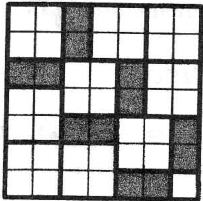
Fig. 2

Fig. 3
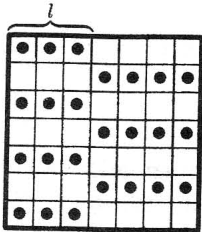
Fig. 4
Now let . We partition the table (see Fig. 2) into the squares and the figures which is shown in Fig. 1. At least one pawn must stand in each of these figures, otherwise at least pawns stand in the square adjoining with the given figure (see Fig. 3), a contradiction. So the total number of the pawns in the table is greater than or equal to .
On the other hand, since exactly empty cells must be in any square, the total number of the empty cells is also greater than or equal to . Hence the number of the pawns in the table is less than or equal . The following example (see Fig. 4) shows that any value of the number of the pawns from the stated interval is admissible. (In this example the total number of the pawns is equal to , where .)
Want a route through all this instead of an archive? The track
puts 2,604 problems in a working order, from Junior Challenge level to the IMO shortlist.