Maths Olympiad Prep

Library / /23 of 101

Geometry Difficulty 5.6 AIME, harder Prove it Estonia

A circle with diameter ABAB intersects side BCBC of rhombus ABCDABCD at point KK. A circle with diameter ADAD intersects side CDCD of rhombus ABCDABCD at point LL. Find the angles of rhombus ABCDABCD if AKL=ABC\angle AKL = \angle ABC.

Solutions — 3

Solution 1

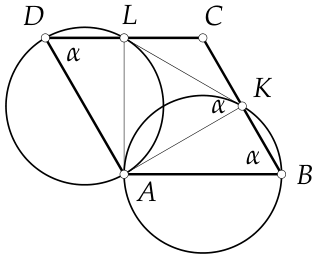
Let ABC=ADC=α\angle ABC = \angle ADC = \alpha; then AKL=α\angle AKL = \alpha (Fig. 28).

According to Thales' theorem AKAK is perpendicular to BCBC and ALAL is perpendicular to CDCD. But ABK=α=ADL\angle ABK = \alpha = \angle ADL and AB=ADAB = AD, so ABKABK and ADLADL are equal. Therefore, AK=ALAK = AL from which ALK=α\angle ALK = \alpha.

As the sum of the internal angles of a quadrilateral is 360360^\circ, we have
KAL=360KCLAKCALC=360(180α)290=α. \angle KAL = 360^\circ - \angle KCL - \angle AKC - \angle ALC = 360^\circ - (180^\circ - \alpha) - 2 \cdot 90^\circ = \alpha.

Figure 1
Fig. 28

Therefore, the triangle AKLAKL is equilateral as all its angles are equal to α\alpha, implying that the angles of the rhombus are 6060^\circ and 120120^\circ.

Solution 2

As in Solution 1, denote α=ABC=ADC=AKL\alpha = \angle ABC = \angle ADC = \angle AKL and show that triangles ABKABK and ADLADL are equal. Therefore, BK=DLBK = DL from which CK=CLCK = CL. We have KCL=180α\angle KCL = 180^\circ - \alpha, therefore CKL=CLK=α2\angle CKL = \angle CLK = \frac{\alpha}{2}.

Thus 90=AKC=AKL+LKC=32α90^\circ = \angle AKC = \angle AKL + \angle LKC = \frac{3}{2}\alpha from which α=60\alpha = 60^\circ. Therefore, the angles of the rhombus are 6060^\circ and 120120^\circ.

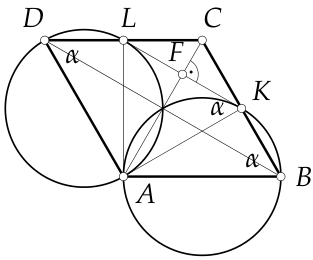
Figure 2
Fig. 29

Solution 3

As in Solution 1, denote α=ABC=ADC=AKL\alpha = \angle ABC = \angle ADC = \angle AKL and show that triangles ABKABK and ADLADL are equal. Hence, BK=DLBK = DL from which BKBC=DLCD\frac{BK}{BC} = \frac{DL}{CD}. Thus KLBDKL \parallel BD and ACKLAC \perp KL. Let ACAC and KLKL meet at FF (Fig. 29).

The altitude KFKF from the right angle of triangle CKACKA divides the triangle to two triangles CFKCFK and KFAKFA, both similar to CKACKA. Therefore, ACK=AKF=α\angle ACK = \angle AKF = \alpha. The diagonal of the rhombus is also the angle bisector, therefore, BCD=2α\angle BCD = 2\alpha. Equation 180α=2α180^\circ - \alpha = 2\alpha gives us α=60\alpha = 60^\circ and the angles of the rhombus are 6060^\circ and 120120^\circ.

Figure 2
Fig. 29

Want a route through all this instead of an archive? The track puts 2,000 problems in a working order, from AMC 10 level to the IMO shortlist.

Source: MathNet, licensed CC-BY-4.0. Statement and solution reproduced as published; topic and difficulty added by this site.