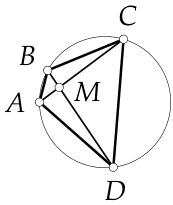
Let M be the intersection of the diagonals of a cyclic quadrilateral ABCD. Find the length of AD, if it is known that AB=2 mm, BC=5 mm, AM=4 mm, and CMCD=0.6.
Solution
Opposite angles AMB and DMC equal. Also notice that ∠ABM=∠ABD=∠ACD=∠MCD, as ABD and ACD are subtended to the same arc. Therefore the triangles AMB and DMC are similar. Hence BMBA=CMCD, from which BM=BA⋅CDCM. Analogously the opposite angles AMD and BMC are equal. By the property of inscribed angles ∠ADM=∠ADB=∠ACB=∠MCB. Hence, the triangles AMD and BMC are similar and AMAD=BMBC. In summary, AD=BMAM⋅BC=2 mmAM⋅5 mm⋅0.6=6 mm. Fig. 1
Want a route through all this instead of an archive? The track
puts 2,604 problems in a working order, from Junior Challenge level to the IMO shortlist.
Source: MathNet,
licensed CC-BY-4.0.
Statement reproduced verbatim; metadata (topic, difficulty) added by this project.