Proof 1. (1) Let A1 be the reflection of A across B. By the given conditions, KPA1A forms an isosceles trapezoid, thus ∠APB=∠A1KB.
Similarly, let A2 be the reflection of A across C. We have ∠AQC=∠A2KC=∠A2KB.
Hence, the desired conclusion is equivalent to ∠BTC=∠A1KA2.
Perform a homothety centered at A with a ratio of 1/2 on △A1KA2, mapping A1 to B, A2 to C, and K to the midpoint of AK (denoted as M). The proposition then transforms to ∠BTC=∠BMC, i.e., points B,C,M, and T are concyclic.
By the Power of a Point Theorem, this is equivalent to proving KB⋅KC=KM⋅KT. If we take X as the midpoint of KT, it is equivalent to proving KB⋅KC=KA⋅KX, i.e., points A,B,C, and X are concyclic.
We note that the perpendicular bisector of segment KP passes through point B and is perpendicular to AB, and the perpendicular bisector of KQ passes through C and is perpendicular to AC. Hence, the circumcenter of △PQK (denoted as O) is the antipodal point of A on the unit circle. From OX⊥KT, we have ∠OXA=2π, and thus X lies on the circle with diameter AO (the circumcircle of △ABC). Proof completed.
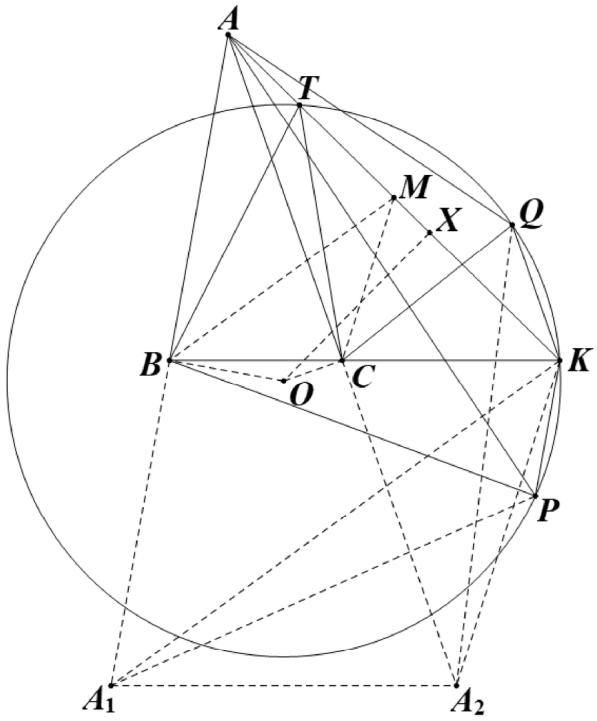
(2) We have
CQBP=CKBK=S△CTKS△BTK=CTBT⋅sin∠CTKsin∠BTK=CTBT⋅sin∠MBKsin∠MCK=CTBT⋅CMBM=CTBT⋅KA2KA1=CTBT⋅AQAP.
Proof completed.
Proof 1 (Alternative). An alternative proof that points B,C,M, and T are concyclic.
Since K,P,Q, and T are concyclic, by Ptolemy's Theorem, KT⋅PQ=PK⋅QT+QK⋅PT. Also, by the Law of Sines, sin∠PKQPQ=sin∠TKQTQ=sin∠PKTPT, hence
KT=PQPK⋅QT+QK⋅PT=sin∠PKQPK⋅sin∠TKQ+QK⋅sin∠PKT.
Let ∠ABC=∠B and ∠ACB=∠C.
Noting that KP=2BKcos∠B and KQ=2CKcos∠C, and utilizing the parallel relationships given in the problem, we obtain
KT=sin(∠B+∠C)2BKcos∠B⋅sin∠CAK+2CKcos∠C⋅sin∠BAK=sin(∠B+∠C)2BKcos∠B⋅KAKCsin∠C+2CKcos∠C⋅KAKBsin∠B=sin(∠B+∠C)cos∠B⋅sin∠C+cos∠C⋅sin∠B⋅KA2KB⋅KC=KMKB⋅KC,
therefore KM⋅KT=KB⋅KC. By the Power of a Point Theorem, it follows that points B,C,M, and T are concyclic. Proof completed.
Proof 2. Let's consider the circumcircle of △ABC as the unit circle in the complex plane. We use uppercase letters for points and the corresponding lowercase letters for their complex numbers.
Let X be the intersection point of the line segment AK with the unit circle. Then
kˉ=ax−bca+x−b−c.
Thus,
k=aˉxˉ−bˉcˉaˉ+xˉ−bˉ−cˉ=ax1−bc1a1+x1−b1−c1=bc−axbc(x+a)−ax(c+b)=ax−bc(ax−ac−cx)b+axc.
Note the following geometric facts: the perpendicular bisector of KP passes through B and is perpendicular to AB, the perpendicular bisector of KQ passes through C and is perpendicular to AC. Therefore, the circumcenter of △PQK is the diametrically opposite point of A on the unit circle, denoted as A1. From ∠AXA1=2π, we know X is the midpoint of TK.
Therefore,
k=ax1−bc1a1+x1−b1−c1=bc−axbc(x+a)−ax(c+b)=ax−bc(ax−ac−cx)b+axc.
We observe the following geometric facts: The perpendicular bisector of the segment KP is the line passing through point B and perpendicular to AB, and the perpendicular bisector of KQ is the line passing through C and perpendicular to AC. Therefore, the circumcenter of △PQK is the diametrical opposite point of A on the unit circle, denoted as A1. Thus, according to ∠AXA1=2π, we know that X is the midpoint of TK.
So
tt−bt−c=2x−k=2x−ax−bc(ax−ac−cx)b+acx=ax−bc2ax2−(ax−ac+cx)b−axc,=ax−bc2ax2−(ax−ac+cx)b−axc−axb+b2c=ax−bc(b−x)(bc+ac−2ax),=ax−bc2ax2−(ax−ac+cx)b−axc−axc+bc2=ax−bc(c−x)(ab+bc−2ax).
On the other hand, since Q and K are symmetric about the line CA1 (noting that a1=−a), we have
c+aq+a=c+ak+a=a+c(kˉ+aˉ)ac=a+cackˉ+c,
thus q=−a+c+ackˉ=(c−a)+ax−bcac(a+x−b−c). Hence,
q−cq−a=ax−bc−a(ax−bc)+ac(a+x−b−c)=ax−bc−a2x+a2c+acx−ac2=ax−bca(a−c)(c−x),=ax−bc(c−2a)(ax−bc)+ac(a+x−b−c)=ax−bcabc−bc2−2a2x+2acx+a2c−ac2=ax−bc(a−c)(ac+bc−2ax).
Similarly, we have p=−a+b+abkˉ=(b−a)+ax−bcab(a+x−b−c). Thus,
p−bp−a=ax−bc−a(ax−bc)+ab(a+x−b−c)=ax−bc−a2x+a2b+abx−ab2=ax−bca(a−b)(b−x),=ax−bc(b−2a)(ax−bc)+ab(a+x−b−c)=ax−bcabc−b2c−2a2x+2abx+a2b−ab2=ax−bc(a−b)(ab+bc−2ax).
Therefore, we arrive at
t−bt−c⋅p−ap−b=q−aq−c,
and by taking the argument of both sides of this equation, we obtain conclusion (1); by taking the modulus, we obtain conclusion (2).