Let be an acute triangle with the perimeter of . We are given three pairwise disjoint circles with pairwise disjoint interiors with the centres , and , respectively. Prove that there exists a circle with the radius of which contains all the three circles.
Czech Republic competition problems
Solution
To simplify the formulations, we say that a point lies inside of the circle if it lies on that circle or in its interior. Assume we are given a circle with the radius of and the centre . A circle with the centre contains the circle if and only if its radius is at least .
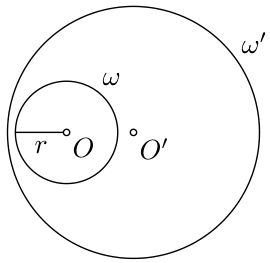
Denote by , , the radii of our circles with the centres at , and , respectively. Using our observation three times indicates that the centre of the circle we are seeking has to meet , or equivalently , and analogously and .
Notice that the numbers , and are positive. We will show this for . Since our circles are disjoint with disjoint interiors, we know that and . This gives us , which indeed means that is a positive number.
Now we may consider three circles with the centres , and and radii , and , respectively. If we prove that there is a point lying inside each of them, we will be done.
Each two of these three circles intersect at two points, because for example (and also ). For the sake of contradiction assume there is no point lying inside all of them. Then the situation looks like on the picture, that is, there exists a point inside of the triangle which lies outside of the three circles (see the remark at the end):
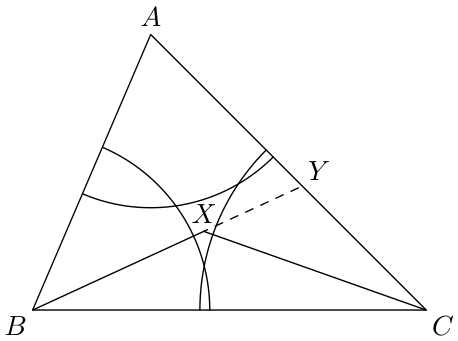
For such we have . This is not possible, however. Let be the intersection of and . Then using the triangle inequalities for the triangles , we get
Similarly and . Summing these three inequalities we obtain , which is a contradiction.
Remark. If three circles , and with the centres , and , respectively, satisfy the conditions that each two of them intersect and there is no point lying inside all of the three circles, then there exists a point in the interior of the triangle which lies outside of each of the three circles.
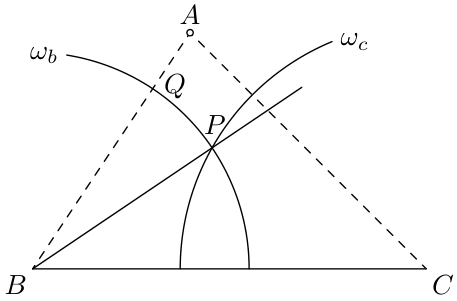
To prove this, consider the intersection point of and which lies in the halfplane determined by the line and the point . The intersection of the ray with lies inside of , since it is the closest point of to (this is true even if is inside of , since ). Therefore cannot lie in the angle (otherwise would lie inside all of the three circles). But that means lies in the interior of the angle . Similarly lies in the interior of the angle . So we have that lies in the interior of the triangle . Since does not lie inside of , there is a point in the neighbourhood of lying outside of all the three circles.
Want a route through all this instead of an archive? The track
puts 2,604 problems in a working order, from Junior Challenge level to the IMO shortlist.