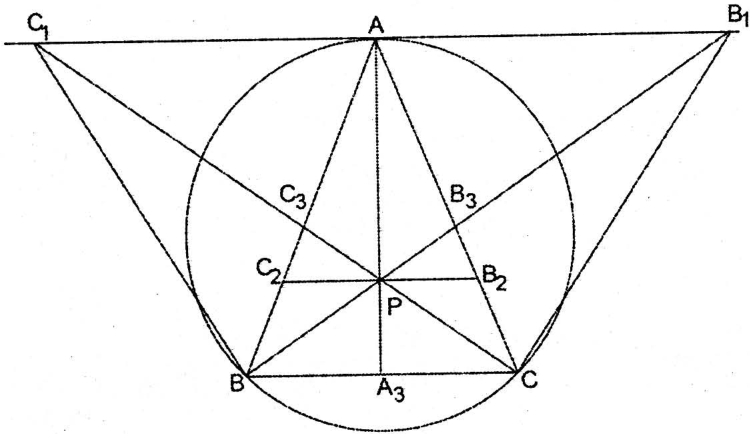
Triangle ABC is inscribed in circle ω. Line ℓ is tangent to ω at A. Points B1 and C1 lie on ℓ such that rays CA and BA bisect BCB1 and CBC1, respectively. Segments BB1 and CC1 intersect at P. The line through P parallel to segment BC intersects sides AC and AB at B2 and C2, respectively. Prove that if P is the midpoint of B2C2 then ABC is isosceles.
Solution
Assume that P is the midpoint of segment B2C2; that is, B2P=C2P. We will show that AB=AC.
Set ABC=B, BCA=C, and CAB=A. Extend segment AP through P to meet segment BC at A3. Then it is clear A3 is the midpoint of side BC or BA3=A3C. Let B3,C3 denote the intersections of pairs of segments BB1 and AC, CC1 and AB, respectively. By Ceva's theorem, we have C3B⋅A3C⋅B3AAC3⋅BA3⋅CB3=1orC3BAC3=B3CAB3
Note that AB3/CB3 is equal to the ratio between the areas of triangle ABB1 and CBB1; that is, CB3AB3=[CBB1][ABB1]=BC⋅CB1⋅sinBCB1AB⋅AB1⋅sinBAB1=BCAB⋅CB1AB1⋅sinBCB1sinBAB1. Because line AB1 is tangent to ω, C1AB=ACB=C. Hence sinBAB1=sinC1AB=sinC and sinBCB1sinBAB1=sin2CsinC=cosC1. Because line AB1 is tangent to ω, we also have B1AC=ABC=B. Thus, triangle AB1C is similar to triangle BAC. By the Law of sines, we have BCAB=sinAsinCandCB1AB1=sinBsinC. It follows that CB3AB3=BCAB⋅CB1AB1⋅sinBCB1sinBAB1=sinAsinBcosCsin2C. In exactly the same way, we can show that BC3AC3=sinAsinCcosBsin2B. It follows that sinAsinBcosCsin2C=CB3AB3=BC3AC3=sinAsinCcosBsin2B. or sin2CtanC=sin2BtanB. Because we can have at most one of tanB and tanC being negative, we must have both of them positive, from which it follows that B and C are acute angles. For 0∘<α<90∘, both sinα and tanα are monotonically increasing, thus we must have B=C, as desired.
Want a route through all this instead of an archive? The track
puts 2,604 problems in a working order, from Junior Challenge level to the IMO shortlist.
Source: MathNet,
licensed CC-BY-4.0.
Statement reproduced verbatim; metadata (topic, difficulty) added by this project.