Two players share a pile of coins, alternating in taking one coin off the pile and placing it on any empty square of a chessboard. The player who puts the coin onto the board in such a way that together with three other coins already on the board it forms a non-rectangular isosceles trapezoid with bases parallel to two of the edges of the board, wins. Which of the players has the winning strategy – the first or the second?
Slovenian Mathematical Olympiad, 2008
Solution
Let us call a non-rectangular isosceles trapezoid with the bases parallel to two of the edges of the board regular. We show that the second player can always win. After the first player's every move the second player should check to see if they can form a regular trapezoid by the placing of a single coin. If not, the second player should put the coin onto the board in such a way, that after their move the arrangement of the coins will have the vertical line across the middle of the board as its axis of symmetry (i.e. the second player's move mirrors the first player's move with regard to this line).
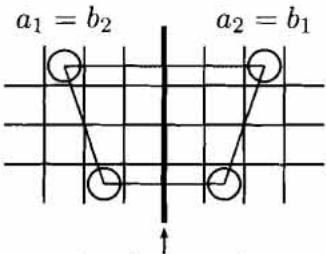
Assume that the first player wins by placing a coin onto the square which we denote by . Let and denote the other three squares that together with form a regular trapezoid (i.e. all four are different and each contains a coin). Let and be the corresponding mirror images. Squares and contain coins and is empty. First, we show that none of the squares and coincide.
Since the length of the board is even, we have for all . If for some , then , so the side of the trapezoid is horizontal. If this is the case, the side for is also horizontal, because a regular trapezoid has no right angles. Since this trapezoid is isosceles, we get and for . This implies for some . A contradiction, the square is empty and squares contain coins.
Hence, all those squares are necessarily different and before the first player made his or her last move the triples and were covered with coins. This implies that at least one of the triples was covered with coins before the second player made his or her last move, so following the strategy the second player should already have won.
Want a route through all this instead of an archive? The track
puts 2,604 problems in a working order, from Junior Challenge level to the IMO shortlist.