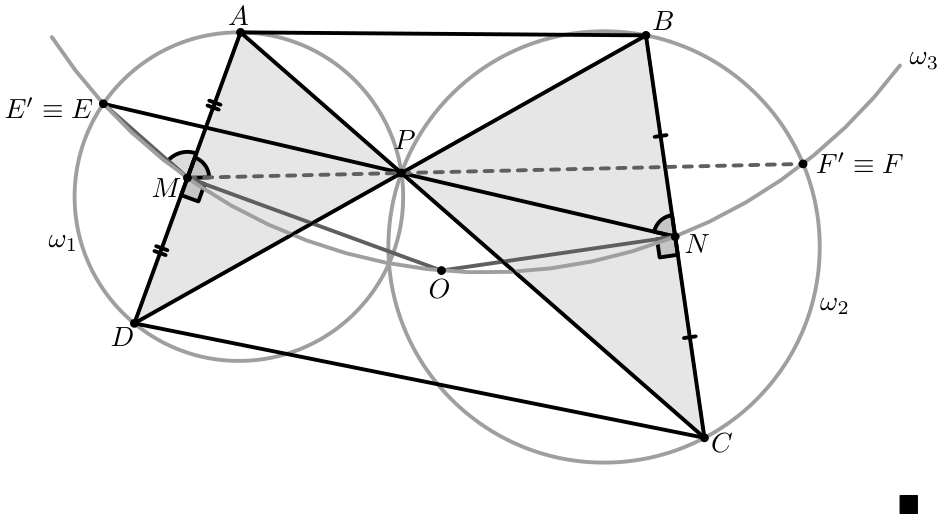
Cyclic quadrilateral ABCD with circumcenter O is given. Point P is the intersection of diagonals AC and BD. Let M and N be midpoints of the sides AD and BC, respectively. Suppose that ω1, ω2 and ω3 are circumcircles of triangles ADP, BCP and OMN, respectively. Let E and F be intersection points of ω1 and ω3, which is not on the arc APD of ω1, and the intersection point of ω2 and ω3, which is not on the arc BPC of ω2, respectively. Prove that OE=OF.
Solution
Let E′ be the second intersection of NP and ω1. Since △BPC∼△APD we have ∠MPD=∠NPC=∠APE′. So APDE′ is a harmonic quadrilateral. Then ∠E′MA=∠PMA=∠PNB⟹∠E′MO=∠E′MA+90∘=∠PNB+90∘=180∘−∠PNO, hence E′NOM is cyclic and E′≡E. Similarly, we can show that M,P and F are collinear. Finally ∠ENO=90∘−∠PNB=90∘−∠PMA=∠FMO⟹OE=OF.
Want a route through all this instead of an archive? The track
puts 2,604 problems in a working order, from Junior Challenge level to the IMO shortlist.
Source: MathNet,
licensed CC-BY-4.0.
Statement reproduced verbatim; metadata (topic, difficulty) added by this project.