Maths Olympiad Prep

Library / /50 of 53

Algebra Difficulty 7.5 National olympiad, round 2 Prove it China

(1) Prove that there exist five nonnegative real numbers aa, bb, cc, dd and ee with their sum equal to 11 such that for any arrangement of these numbers around a circle, there are always two neighboring numbers with their product not less than 19\frac{1}{9}.

(2) Prove that for any five nonnegative real numbers with their sum equal to 11, it is always possible to arrange them around a circle such that there are two neighboring numbers with their product not greater than 19\frac{1}{9}.

(posed by Qian Zhanwang)

Solution

(1) Let a=b=c=13a = b = c = \frac{1}{3}, d=e=0d = e = 0, it is easy to see that, when arranging them around a circle, we can always get two neighboring numbers of 13\frac{1}{3}, and their product is 19\frac{1}{9}.

(2) For any five nonnegative real numbers aa, bb, cc, dd and ee with their sum equal to 11, without loss of generality, we assume that abcde0a \ge b \ge c \ge d \ge e \ge 0. Arrange these numbers around a circle in such a way as seen in the figure:
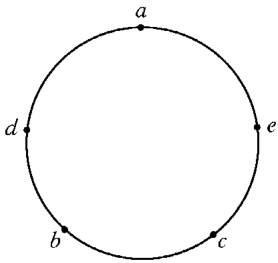
Figure 1

Since a+b+c+d+e=1a + b + c + d + e = 1, we have a+3d1a + 3d \le 1, and
a3d(a+3d2)214a \cdot 3d \le \left(\frac{a + 3d}{2}\right)^2 \le \frac{1}{4}
then ad112ad \le \frac{1}{12}.

Furthermore, a+b+c1a + b + c \le 1, then b+c1a1b+c2b + c \le 1 - a \le 1 - \frac{b + c}{2}, i.e. b+c23b + c \le \frac{2}{3}. So
bc(b+c)2419bc \le \frac{(b + c)^2}{4} \le \frac{1}{9}
Since ceaeadce \le ae \le ad and bdbcbd \le bc, then any neighboring numbers in this arrangement have their product less than 19\frac{1}{9}.

Want a route through all this instead of an archive? The track puts 2,000 problems in a working order, from AMC 10 level to the IMO shortlist.

Source: MathNet, licensed CC-BY-4.0. Statement and solution reproduced as published; topic and difficulty added by this site.