The vertices X, Y, Z of an equilateral triangle XYZ lie respectively on the sides BC, CA, AB of an acute-angled triangle ABC. Prove that the incenter of triangle ABC lies inside triangle XYZ.
The vertices X, Y, Z of an equilateral triangle XYZ lie respectively on the sides BC, CA, AB of a triangle ABC. Prove that if the incenter of triangle ABC lies outside triangle XYZ, then one of the angles of triangle ABC is greater than 120∘.
Solutions — 3
Solution 1
We will prove a stronger fact; namely, we will show that the incenter I of triangle ABC lies inside the incircle of triangle XYZ (and hence surely inside triangle XYZ itself). We denote by d(U,VW) the distance between point U and line VW.
Denote by O the incenter of △XYZ and by r, r′, and R′ the inradii of triangles ABC, XYZ and the circumradius of XYZ, respectively. Then we have R′=2r′, and the desired inequality is OI≤r′. We assume that O=I; otherwise the claim is trivial.
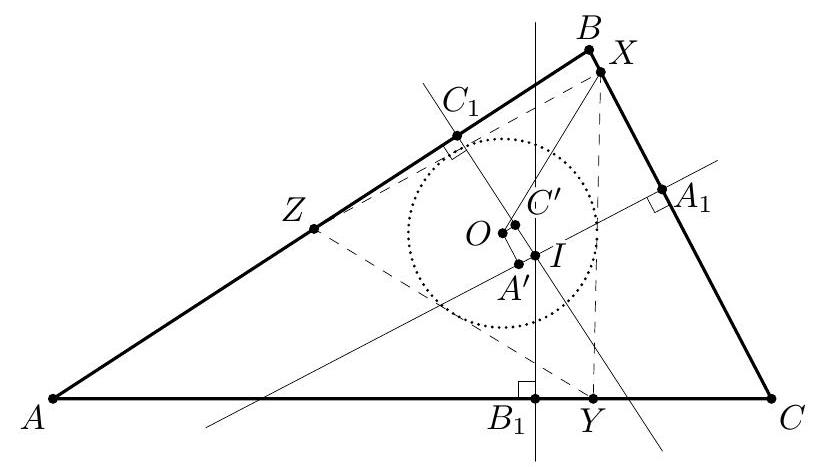
Let the incircle of △ABC touch its sides BC, AC, AB at points A1, B1, C1 respectively. The lines IA1, IB1, IC1 cut the plane into 6 acute angles, each one containing one of the points A1, B1, C1 on its border. We may assume that O lies in an angle defined by lines IA1, IC1 and containing point C1 (see Fig. 1). Let A′ and C′ be the projections of O onto lines IA1 and IC1, respectively.
Since OX=R′, we have d(O,BC)≤R′. Since OA′∥BC, it follows that d(A′,BC)=A′I+r≤R′, or A′I≤R′−r. On the other hand, the incircle of △XYZ lies inside △ABC, hence d(O,AB)≥r′, and analogously we get d(O,AB)=C′C1=r−IC′≥r′, or IC′≤r−r′.
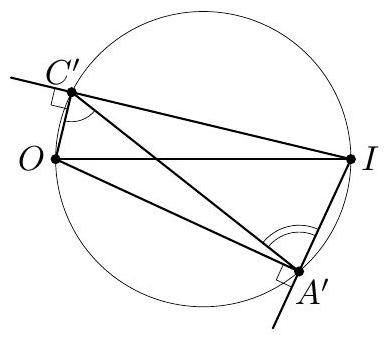
Fig. 1 Fig. 2
Finally, the quadrilateral IA′OC′ is circumscribed due to the right angles at A′ and C′ (see Fig. 2). On its circumcircle, we have A′OC′=2∠A′IC′<180∘=OC′I, hence 180∘≥IC′>A′O. This means that IC′>A′O. Finally, we have OI≤IA′+A′O≤IA′+IC′≤(R′−r)+(r−r′)=R′−r′=r′, as desired.
Solution 2
Assume the contrary. Then the incenter I should lie in one of triangles AYZ, BXZ, CXY - assume that it lies in △AYZ. Let the incircle ω of △ABC touch sides BC, AC at point A1, B1 respectively. Without loss of generality, assume that point A1 lies on segment CX. In this case we will show that ∠C>90∘ thus leading to a contradiction.
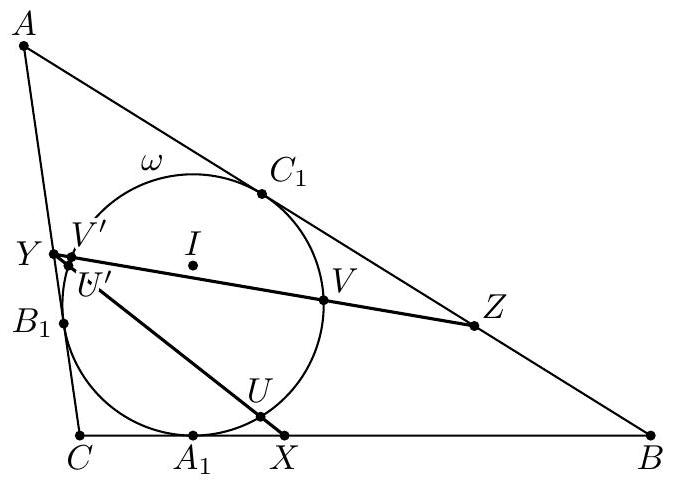
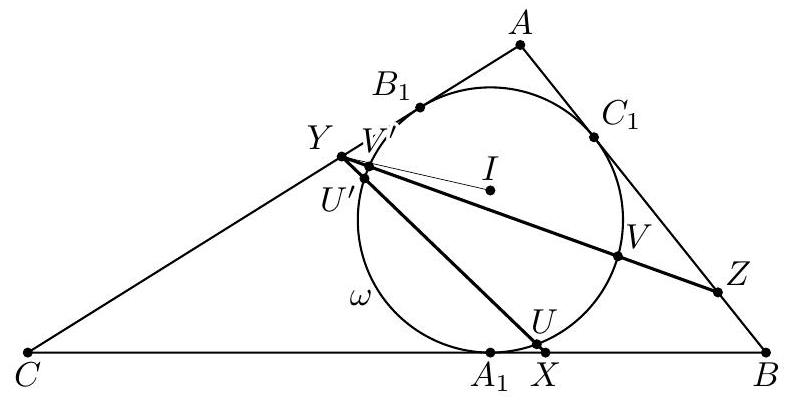
Note that ω intersects each of the segments XY and YZ at two points; let U, U′, and V, V′ be the points of intersection of ω with XY and YZ, respectively (UY>U′Y, VY>V′Y; see Figs. 3 and 4). Note that 60∘=∠XYZ=21(UV−U′V′)≤21UV, hence UV≥120∘.
On the other hand, since I lies in △AYZ, we get UU′<180∘, hence UA1U′≤UA1V′<180∘−UV≤60∘.
Now, two cases are possible due to the order of points Y, B1 on segment AC.
Fig. 3 Fig. 4
Case 1. Let point Y lie on the segment AB1 (see Fig. 3). Then we have ∠YXC=21(A1U′−A1U)≤21A1U′<30∘; analogously, we get ∠XYC≤21A1U′<30∘. Therefore, ∠YCX=180∘−∠YXC−∠XYC>120∘, as desired.
Case 2. Now let point Y lie on the segment CB1 (see Fig. 4). Analogously, we obtain ∠YXC<30∘. Next, ∠IYX>∠ZYX=60∘, but ∠IYX<∠IYB1, since YB1 is a tangent and YX is a secant line to circle ω from point Y. Hence, we get 120∘<∠IYB1+∠IYX=∠B1YX=∠YXC+∠YCX<30∘+∠YCX, hence ∠YCX>120∘−30∘=90∘, as desired.
Solution 3
Assume the contrary. As in Solution 2, we assume that the incenter I of △ABC lies in △AYZ, and the tangency point A1 of ω and BC lies on segment CX. Surely, ∠YZA≤180∘−∠YZX=120∘, hence points I and Y lie on one side of the perpendicular bisector to XY; therefore IX>IY. Moreover, ω intersects segment XY at two points, and therefore the projection M of I onto XY lies on the segment XY. In this case, we will prove that ∠C>120∘.
Want a route through all this instead of an archive? The track
puts 2,604 problems in a working order, from Junior Challenge level to the IMO shortlist.
Source: MathNet,
licensed CC-BY-4.0.
Statement reproduced verbatim; metadata (topic, difficulty) added by this project.