Determine all positive integers such that we can divide a convex -polygon into triangles by using some diagonals of this polygon such that the number of the used diagonals of every vertex is even.
Saudi Arabian Mathematical Competitions
Solution
The answer is .
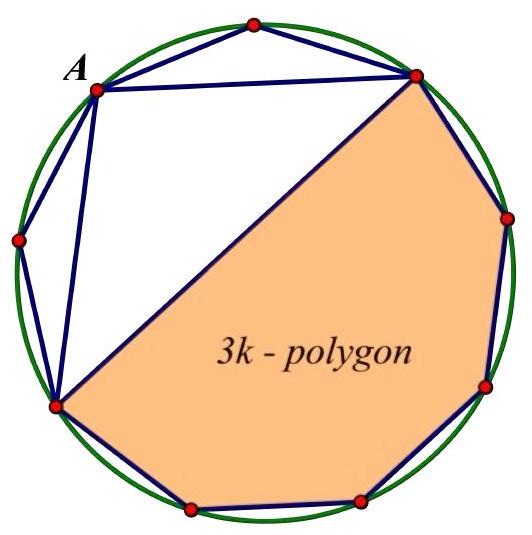
1) We show that if then we can divide every convex -polygon (without overlapping) into triangles by using some diagonals of this polygon such that the number of the used diagonals of every vertex is an even integer. The proof is by induction in . The figure shows how to reduce from -polygon to -polygon.
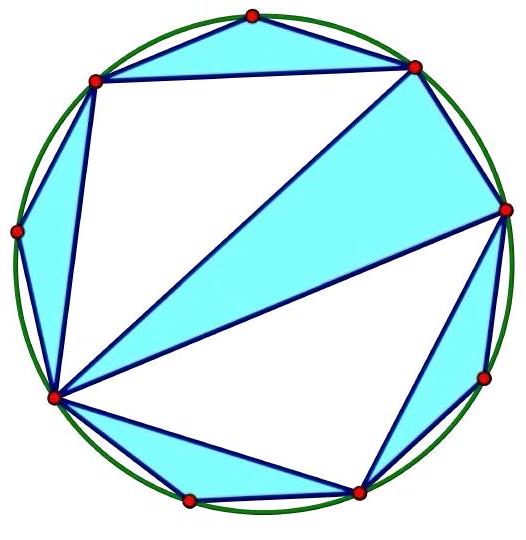
2) We show that if a convex -polygon can divide (non-overlap) a convex -polygon into triangles by using some diagonals of this polygon such that the number of the used diagonals of every vertex is an even integer, then .
First note that the number of triangles is exact using the sum of the angles (this sum is in any convex -polygon). Thus, the number of used diagonals is (by adding all the numbers of sides of the triangles we get number of diagonals). Now, we can color the triangles with white and black in such a way that: One side of the -polygon is black and no adjacent (having one side in common) triangles have the same color.
Since the diagonals of each vertex is even, we easily see that all sides of the -polygon are black. Let denote the number of the black triangles, the sum of the sides of all black triangles is
Want a route through all this instead of an archive? The track
puts 2,604 problems in a working order, from Junior Challenge level to the IMO shortlist.