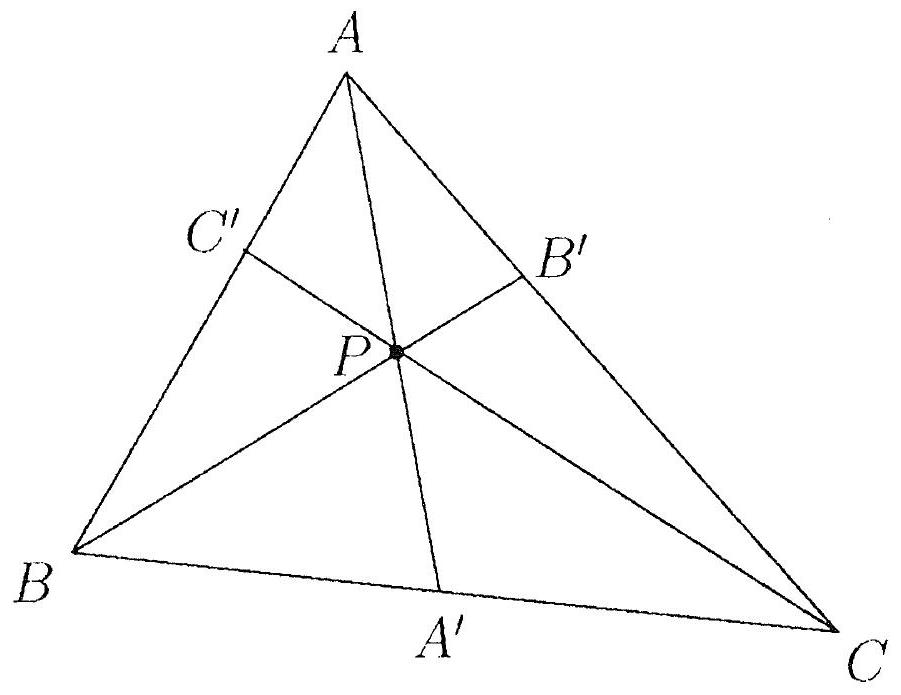
Let AB=c, BC=a, CA=b, BA′=x, CB′=y, AC′=z. The condition in the problem ax+by+cz=23 is equivalent to
bcx+cay+abz=23abc(1)
From Ceva's Theorem,
a−xx⋅b−yy⋅c−zz=1,
so
xyz=(a−x)(b−y)(c−z)=abc−(bcx+cay+abz)+(axy+byz+czx)−xyz
or
2xyz=41abc+43abc−(bcx+cay+abz)+(axy+byz+czx).
The (1) is equivalent to
2xyz=41abc−21(bcx+cay+abz)+(axy+byz+czx),
which can be written as
8xyz−4(axy+byz+czx)+2(bcx+cay+abz)−abc=0
so (2x−a)(2y−b)(2z−c)=0.
This means that at least one of the segments AA′, BB′, CC′ is a median in triangle ABC and the conclusion follows.
Solution 2:
Denote
x=A′BA′C,y=B′CB′A,z=C′AC′B.
From Ceva's Theorem, we have xyz=1.
The condition in the problem is equivalent to
1+x1+1+y1+1+z1=23
That is
2[(x+1)(y+1)+(y+1)(z+1)+(z+1)(x+1)]=3(x+1)(y+1)(z+1)
We obtain
2(xy+yz+zx)+4(x+y+z)+6=3xyz+3(xy+yz+zx)+3(x+y+z)+3
hence
3xyz−(x+y+z)+(xy+yz+zx)−3=0
that is
1−(x+y+z)+(xy+yz+zx)−1=0.
It follows
xyz−(x+y+z)+(xy+yz+zx)−1=0
hence
(x−1)(y−1)(z−1)=0
and the conclusion follows.