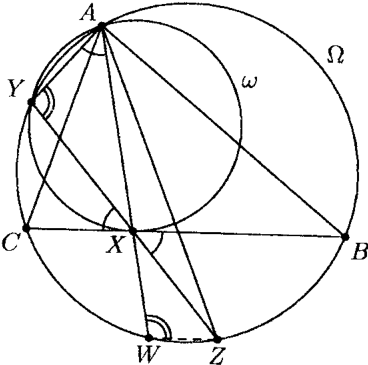
Let be the circumcircle of a triangle . A circle passing through the vertex and touching at point meets at point (different from ). Let point (different from ) be the intersection point of the ray and .
Belarus — Final Round
Solution
Let be the circle passing through and touching the side at . Since the angle subtends the arc , we have .
Further, (as the angle between the tangent and the chord ). So, . Let be the intersection point of the ray and . Then , so . We have as the vertical angles, so . Further, as inscribed angles of subtending the same arc. Therefore, , so . Hence , and then as inscribed angles of subtending the equal arcs.
Want a route through all this instead of an archive? The track
puts 2,604 problems in a working order, from Junior Challenge level to the IMO shortlist.