Find the least real such that there exist reals and for which the inequality
holds for all .
Czech and Slovak Mathematical Olympiad
Solution
Notice that no negative number satisfies the problem evidently (absolute value is non-negative number).
Now we interpret the problem geometrically. A graph of some function lies in a horizontal strip between lines and and in the interval . Our aim is to find the closest strip which contains the graph of such quadratic function in the interval .
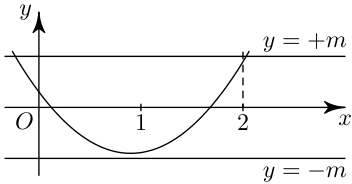
The function
seems to be a good candidate for such the closest strip. Such function has , and it satisfies (to be shown below) inequalities .
Really, this inequalities are equivalent to the inequalities , which are evidently fulfilled for . Quadratic function thus satisfies the conditions of the problem for .
In the second part of the solution we will show that there is no quadratic function satisfying the problem for any .
The crucial fact will be that at least one from differences and is greater or equal to for an arbitrary function . This fact will imply that width of the closest strip will be greater or equal to . This will exclude the values . For we obtain the desired estimate easily from the well-known triangle inequality :
Similarly we estimate for .
Now it remains to verify at least one from inequalities and for arbitrary . The values
yields
So at least one from inequalities and is true (regardless of the choice ).
Conclusion. The desired minimal value of is .
Want a route through all this instead of an archive? The track
puts 2,604 problems in a working order, from Junior Challenge level to the IMO shortlist.