Find the smallest positive integer such that for any coloring of numbers by three colors there exist two numbers with the same color whose difference is a square of an integer. (Vojtech Bálint, Michal Rolínek, Josef Tkadlec)
Czech and Slovak Mathematical Olympiad
Solution
The answer is .
First, for the sake of contradiction, assume that numbers can be colored by colors such that no two numbers with the same color differ by a square. Let be the color of number for .
Since , and are squares, numbers are all assigned distinct colors. The same is true for numbers , hence and are assigned the same color. Likewise we get , and (for the last equality we look at numbers ).
Without loss of generality, assume . As , we have . Without loss of generality, let . Now , hence . Similarly, implies . We have derived , a contradiction.
On the other hand, if , we may color the numbers as below. It's easy to check that no two numbers with the same color differ by a square of an integer.
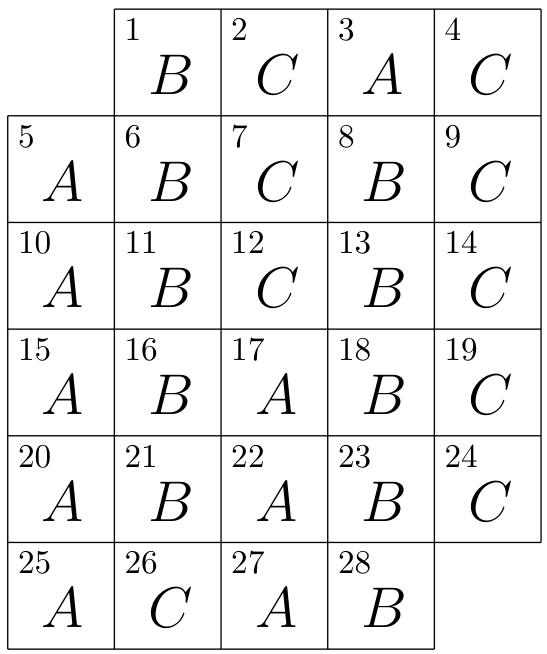
Fig. 4
Want a route through all this instead of an archive? The track
puts 2,604 problems in a working order, from Junior Challenge level to the IMO shortlist.