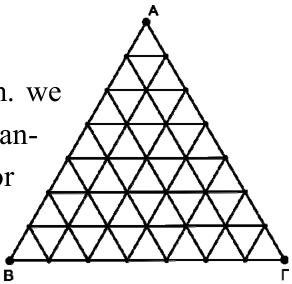
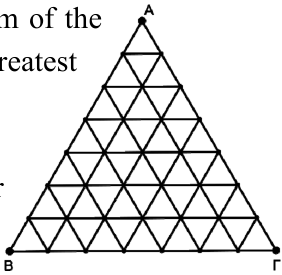
The small triangles are divided in four categories.
1st category: They have one vertex A or B or Γ.
These are not members of any hexagon and so their numbers do not take part in the final sum of values of all hexagons.
2nd category: Contains small triangles which belong only to one hexagon. On every side of ABΓ there exist k−2 such triangles and so totally we have 3(k−2)+3=3k−3 in this category.
3rd category: Contains small triangles which belong exactly to two hexagons. On every side of ABΓ there are k−3 such triangles and so there are totally 3(k−3) triangles in this category.
Note that for the computation of the final sums we must take into account that we will sum two times the numbers of the triangles of the second category.
4th category: Contains small triangles which belong exactly to three hexagons. These triangles are inside the triangle ΔEZ, see figure. These triangles are totally (k−3)2.
In order to obtain the greatest possible sum, we have to put as many as possible big numbers into triangles of higher category (then they will be counted more times). According to this reasoning we must put:
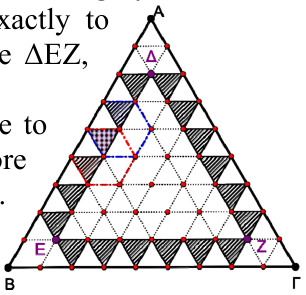
(1) The numbers of the set A={1,2,3} into the triangles of the first category.
(2) The numbers of the set B={4,5,6,…,3k} into 3k−3 triangles of the second category, with partial sum
SB=4+5+6+⋯+3k=24+3k(3k−3)=2(3k−3)(3k+4).
(3) The numbers of the set Γ={(3k+1),(3k+2),…,(6k−9)} into 3k−9 triangles of the third category, with partial sum:
SΓ=(3k+1)+(3k+2)+⋯+(6k−9)=2(3k+1)+(6k−9)(3k−9).
(4) The numbers of the set Δ={(6k−8),(6k−7),…,k2} into k2−6k+9 triangles of the fourth category, with partial sum:
SΔ=(6k−8)+(6k−7)+⋯+k2=2k2+6k−8(k2−6k+9).
Hence the greatest possible sum of values is:
Smax=SA+SB+2SΓ+3SΔ=23(k4−14k2+33k−24).
Let now γ be a member of the set Γ and δ a member of the set Δ. Then in the final sum Smax there exists the summand 2γ+3δ. In the case of interchange of the position of the members of the sets Γ and Δ, then in the final sum Smax we will have the summand 2δ+3γ. Since γ<δ and 2<3, it follows that 2δ+3γ<2γ+3δ. Hence the sum we have found is the maximal.