In the plane are given different points such that any three of them are not collinear. We color these points red, green and black. In the sequel we consider all line segments with ends these points and we correspond to each of them an “algebraic value” according to the following rules:
1) If at least one of the ends of the line segment is black, then it has algebraic value 0.
2) If both ends of the line segment have the same colour, red or green then it has the algebraic value 1.
3) If ends of the line segment have different colour red or green, then it has the algebraic value -1.
Determine the least possible value of the sum of algebraic values of the all line segments.
Greece — Selection Examination
Solution
From the three rules for the determination of the algebraic value of the line segments we have the following table:
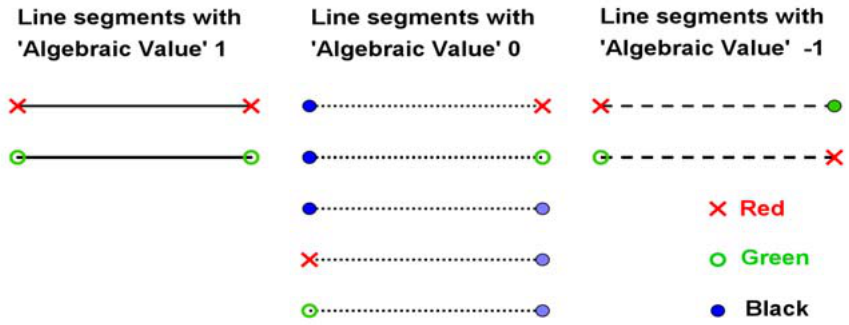
Let now that we have red, green and black points. Then it is clear that .
The red points determine line segments having their ends red and so they have algebraic values 1. The green points determine line segments with both ends green and therefore with algebraic values 1. The number of the line segments having ends with different colors, red or green, and so with algebraic value -1, are . All the other line segments have algebraic value 0, because they have at least one of their ends black.
The sum of the algebraic values of all existing line segments is:
From the last expression of we conclude that:
If is even (let ), then relation (1) becomes: .
Equality in the last relation holds, if and only if and .
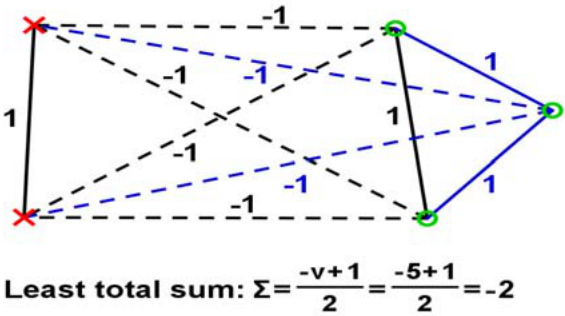
For example, for , we have the following result:
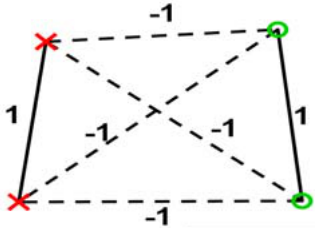
Least total sum:
If is odd (), then relation (1) :
Since is integer we conclude that: .
We check now when equality holds in the last relation. We observe that the case “ odd ()” comes from the case “ even ()” by adding one more point. The point we add in the case “ even ()” can be blank, red or green, and so we have the following cases:
### Case 1
Let the point we add is blank. Then the new produced line segments have algebraic values 0 and the equality in this case holds when: and .
The sum of all algebraic values is: .
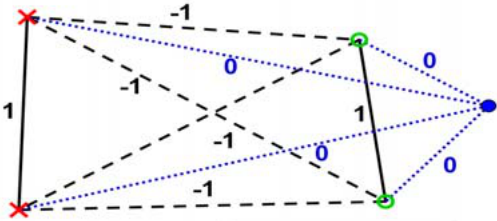
Least total sum:
### Case 2
Let the point we add is red. We had red and green points: . Now with the new point we can create line segments having algebraic value 1 and line segments having algebraic value -1. Equality in this case holds when
The sum of all algebraic values remains: .
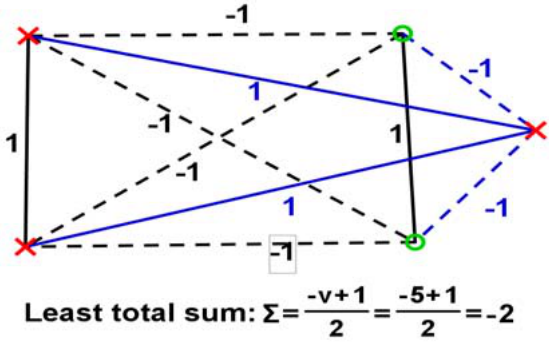
### Case 3
If the point we add is green, in a similar way we conclude that the equality holds when , and . Again: .
From all the above we conclude that the least possible value of is .
Want a route through all this instead of an archive? The track
puts 2,604 problems in a working order, from Junior Challenge level to the IMO shortlist.