The bisector of the exterior angle at vertex of the triangle intersects the bisector of the interior angle at vertex in point . Consider the diameter of the circumcircle of the triangle whose one endpoint is . Prove that lies on this diameter.
Estonia — Open Contests
Solutions — 3
Solution 1
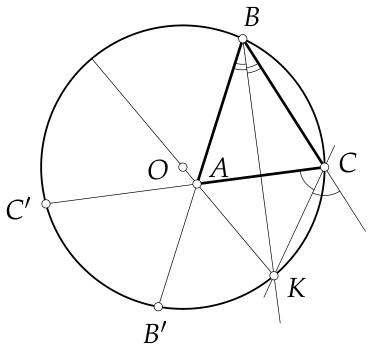
Fig. 9
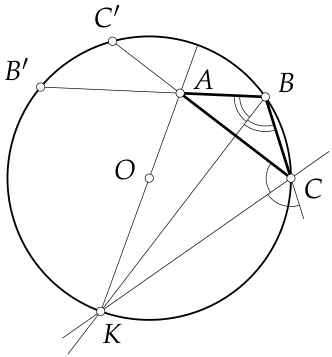
Fig. 10
Let and be respectively the second intersection points of the lines and with the circumcircle of the triangle (Fig. 9). Notice that . Hence the central angle supported by the arc has the size . The central angle supported by the arc has the size and the central angle supported by the arc has the size . Hence the central angle supported by the arc has the size , which equals . Hence the arcs and have the same size. As is the midpoint of the arc , the point is the reflection of the point by the diameter drawn from point , and is the reflection of point . Hence the intersection point of and has to lie on the diameter drawn from the point .
Remark. Among the used central angles there may also be angles of size greater than (reflex angles), such as the angle corresponding to the arc in Fig. 10.
Solution 2
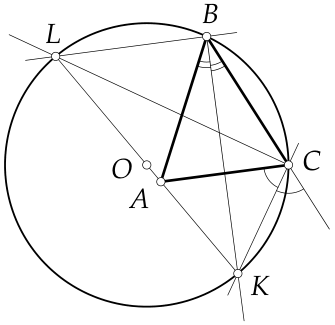
Fig. 11
Let be the second endpoint of the diameter through of the circumcircle of the triangle (Fig. 11). Then , thus is the bisector of the interior angle at vertex of the triangle , and , so is the bisector of the exterior angle at vertex of .
The bisectors of the exterior angles at some two vertices of a triangle and the bisector of the interior angle at the third vertex of the triangle intersect at a common point. Thus the bisector of the exterior angle at vertex of the triangle passes through points and . Thus point lies on .
Solution 3
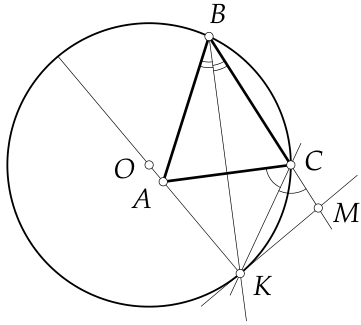
Fig. 12
Let us denote the angles of the triangle at vertices , and respectively , and . Let the intersection point of the line and the tangent to the circumcircle of triangle at point be (Fig. 12). By the property of inscribed angles, . The bisectors of the exterior angles at some two vertices of a triangle and the bisector of the interior angle at the third vertex of the triangle have a common point. Hence is the bisector of the exterior angle at vertex of the triangle .
---
Thus .
Hence . As a tangent of a circle is perpendicular to the diameter drawn from the point of tangency we have that lies on the diameter drawn from point .
Want a route through all this instead of an archive? The track
puts 2,604 problems in a working order, from Junior Challenge level to the IMO shortlist.