Let be an acute triangle with , and let be its circumcircle. Let , , and be the orthocenter of the triangle, the midpoint of , and the foot of the altitude from , respectively. Let and be the two points on that satisfy and . Prove that the circumcircles of the triangles and are tangent to each other.
IMO Shortlist
Solutions — 2
Solution 1
Consider any point such that is tangent to the circle at with and lying on different sides of (see Figure 1). Then and we are to prove that . Thus it remains to show that . Due to , and , this means the same as . Now, since the triangles and are similar with and being the midpoints of corresponding sides, we have , and analogously one may obtain . Thereby our task is reduced to verifying
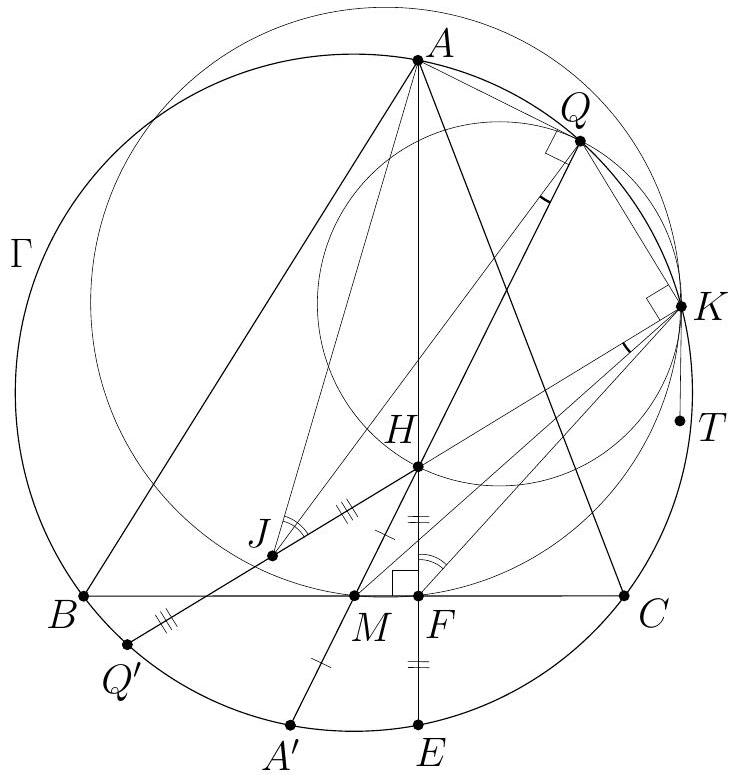
Figure 1
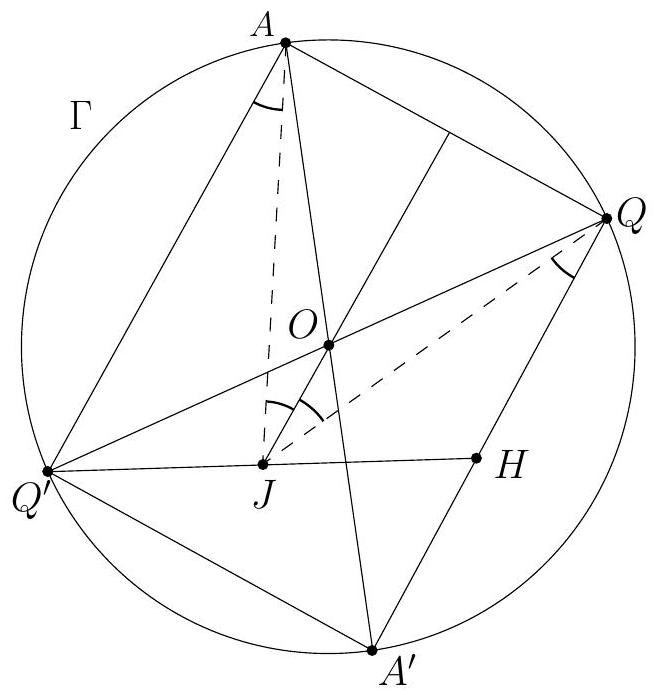
Figure 2
To avoid confusion, let us draw a new picture at this moment (see Figure 2). Owing to and , we just have to show that . To this end, it suffices to remark that is a rectangle and that , being defined to be the midpoint of , has to lie on the mid parallel of and .
Solution 2
We define the points and and prove that the ray passes through in the same way as in the first solution. Notice that the points and can play analogous roles to the points and , respectively: point is the second intersection of the line with , and is the point on with the property (see Figure 3).
In the circles and , the line segments and are diameters, respectively; so, these circles have a common tangent at , perpendicular to . Let be the radical center of the circles and . Their pairwise radical axes are the lines , and the line ; they all pass through . Let be the midpoint of ; by , the quadrilateral is cyclic and its circumcenter is ; hence we have . The line , being the perpendicular bisector of , passes through .
The circle also is tangent to at ; from the power of with respect to the circle we have
So, the power of with respect to the circles and is . Therefore, the line segment is tangent to both circles at .
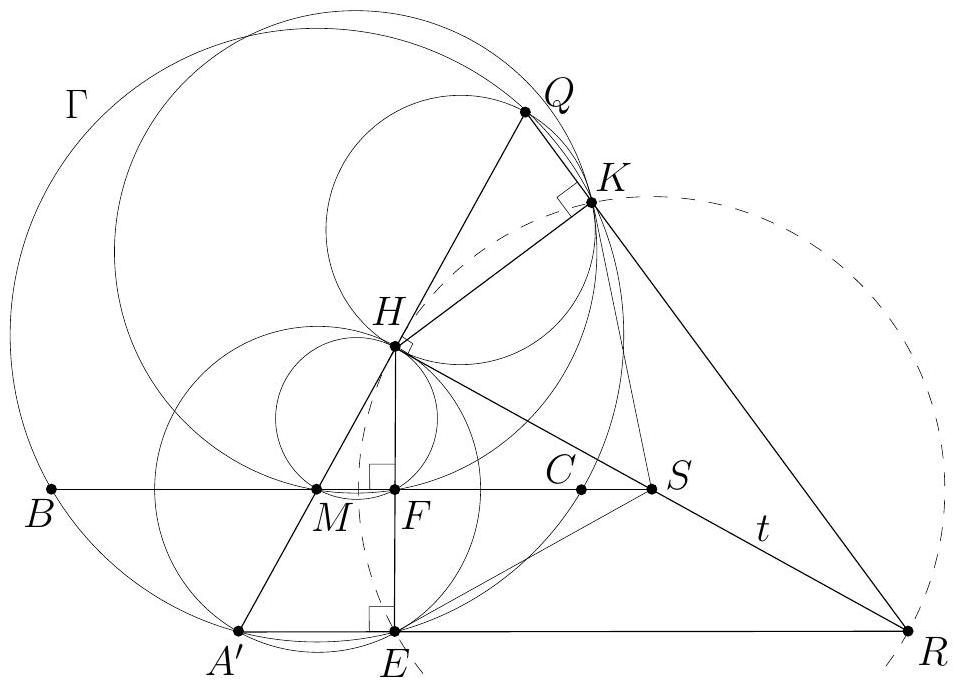
Figure 3
Want a route through all this instead of an archive? The track
puts 2,604 problems in a working order, from Junior Challenge level to the IMO shortlist.