Maths Olympiad Prep

Library / /33 of 46

Geometry Difficulty 6.6 National olympiad Prove it Russia

Segment BDBD is an angle bisector in a triangle ABCABC (point DD lies on segment ACAC). Line BDBD intersects the circumcircle Ω\Omega of triangle ABCABC at points BB and EE. Circle ω\omega with diameter DEDE intersects Ω\Omega at points EE and FF. Prove that the line symmetrical to BFBF with respect to BDBD contains a median of triangle ABCABC.

(L. Emelyanov)

Solutions — 2

Solution 1

Let MM be the midpoint of side ACAC, the line BMBM intersects the circle Ω\Omega again at point FF', and the line FMFM intersects the circle Ω\Omega again at point BB' (see Fig. 20).

Since arcs AEAE and CECE are equal, points MM and EE lie on the perpendicular bisector \ell of segment ACAC. Therefore, EMD=90\angle EMD = 90^\circ and, consequently, MM lies on the circle ω\omega.

We have:
12BCE=BFE=MFE=MDE=CDE=12(AB+CE)=12(AB+AE)=12BAE. \frac{1}{2}\overline{B'C'E} = \angle B'FE = \angle MFE = \angle MDE = \angle CDE = \frac{1}{2}(\overline{AB} + \overline{CE}) = \frac{1}{2}(\overline{AB} + \overline{AE}) = \frac{1}{2}\overline{BAE}.
From the equality of arcs BCEB'C'E and BAEBAE, it follows that points BB and BB' are symmetric with respect to \ell, so lines BMBM and BMB'M (and therefore points FF' and FF) are symmetric with respect to \ell. The last statement means that EF=EF\overline{EF} = \overline{EF'}, whence FBE=FBE\angle FBE = \angle F'BE. We obtain that lines BFBF and BMBM are symmetric with respect to line BEBE, which is what was required to be proved.
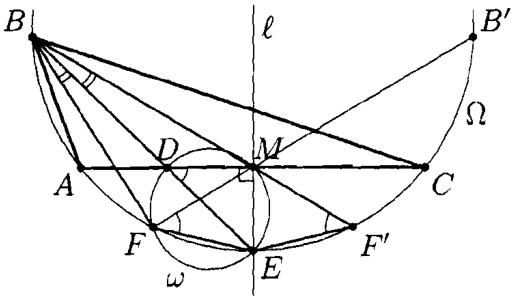
Figure 1

Solution 2

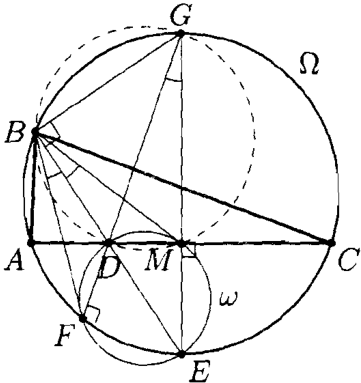
Let MM be the midpoint of side ACAC. As in the previous solution, we obtain that MEME is the perpendicular bisector of ACAC, and MM lies on ω\omega. Let the line DFDF intersect the circle Ω\Omega again at point GG. Since DFE=90\angle DFE = 90^\circ, GG is the point diametrically opposite to EE; in particular, EGEG passes through MM (see Fig. 21). We have FBE=FGE\angle FBE = \angle FGE.

Furthermore, since EGEG is a diameter, GBE=90\angle GBE = 90^\circ. From the equalities GBD=GMD=90\angle GBD = \angle GMD = 90^\circ, it follows that GBDMGBDM is a cyclic quadrilateral (with diameter DGDG), whence MBE=MBD=MGD=EGF\angle MBE = \angle MBD = \angle MGD = \angle EGF. Thus, FBE=FGE=MBE\angle FBE = \angle FGE = \angle MBE, which is what was required to establish.

Figure 2

Want a route through all this instead of an archive? The track puts 2,000 problems in a working order, from AMC 10 level to the IMO shortlist.

Source: MathNet, licensed CC-BY-4.0. Statement and solution reproduced as published; topic and difficulty added by this site.