On a chessboard, some unit square fields are chosen to form a region . This region can be tiled by squares. If can also be tiled by a combination of pieces of the following types of shapes (with rotations allowed).
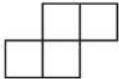
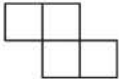
Determine the minimum value of . (Posed by Zhu Huawei)
China Girls' Mathematical Olympiad
Solution
The answer is . We call those two kinds of nonsquare tiles ducks.
First, the left-hand-side figure and the middle figure below show that works.
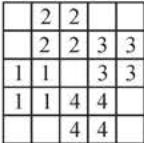
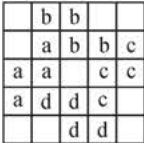
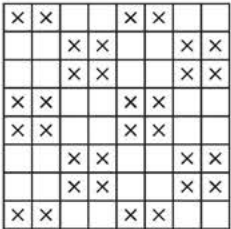
Second, we show that must be even. We mark the (infinite) chessboard with in the pattern indicated in the right-hand-side figure. It is easy to see that each covers exactly an even number of crosses (either two or four crosses) and each duck covers exactly an odd number of crosses (either one or three crosses). It follows that we must have an even number of ducks in , i.e. is even.
Third, we show that . If , then can be tiled by two squares. It is clear that these two squares much share a common edge. Hence, we can have only two possibilities:
Want a route through all this instead of an archive? The track
puts 2,604 problems in a working order, from Junior Challenge level to the IMO shortlist.