In an acute triangle we have . Let and be two points on the sides and such that . Denote the intersection of the segments and by and let be a point on the segment such that the line is parallel to the bisector of the angle . Prove that .
Slovenian Mathematical Olympiad, 2008
Solution
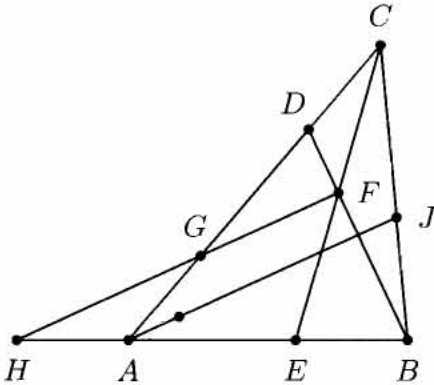
Denote the intersection of lines and by and let be the point where the bisector of the angle meets the segment . Since the line is parallel to , we have , so the triangle is isosceles and . We know that and from what we just proved . It remains to be seen that . The figure reveals no similar triangles, so we have to find a different way to use the equality of lengths. Lengths play an important role in Ceva's and Menelaus's theorem. The former does not apply here, but we can try to use the latter.
Menelaus's theorem for the triangle and the line states that
and since we get . Now, let us try to express the ratio in another way. Menelaus's theorem for the triangle and the line gives us
and since we have . Hence, . This is equivalent to
which implies . Since , we have
so , and, finally, , which was to be shown.
Want a route through all this instead of an archive? The track
puts 2,604 problems in a working order, from Junior Challenge level to the IMO shortlist.