Maths Olympiad Prep

Library / Slovenian Mathematical Olympiad /56 of 68

Slovenian Mathematical Olympiad, 2008

Geometry Difficulty 6.3 National Olympiad Prove it Slovenia

Let ABCABC be a right triangle with the right angle at CC. On the segment BCBC choose a point DD different from BB and CC. Denote the circumcircle of the triangle ABDABD by K\mathcal{K}. Let TT be a point on the side ABAB such that DTDT is perpendicular to ABAB. Let EE be the second intersection of the line DTDT with K\mathcal{K}, denote the intersection of lines CTCT and EBEB by FF and let the line DFDF meet K\mathcal{K} again at GG. Prove that triangles CEFCEF and BEGBEG are similar.

Solution

The sum of the two opposite angles ∠ATD\angle ATD and ∠ACD\angle ACD in the quadrilateral ATDCATDC is π\pi, so this quadrilateral is cyclic. Set ∠TCD=α\angle TCD = \alpha. Then

∠TAD=∠TCD=α\angle TAD = \angle TCD = \alpha. Points AA, BB, EE, DD are concyclic, so ∠BED=∠BAD=∠TAD=α\angle BED = \angle BAD = \angle TAD = \alpha. We have ∠FED=∠BED=α=∠TCD=∠FCD\angle FED = \angle BED = \alpha = \angle TCD = \angle FCD, so angles FEDFED and FCDFCD in the quadrilateral FECDFECD are equal and this quadrilateral is also cyclic.

Let ∠ECF=β\angle ECF = \beta. Since FECDFECD is cyclic, we have ∠EDF=∠ECF=β\angle EDF = \angle ECF = \beta. Points EE, DD, BB and GG all lie on K\mathcal{K}, so ∠EBG=∠EDG=∠EDF=β\angle EBG = \angle EDG = \angle EDF = \beta.

Denote ∠EFC=γ\angle EFC = \gamma. Since the quadrilateral CDFECDFE is cyclic, we have ∠EDC=∠EFC=γ\angle EDC = \angle EFC = \gamma, so ∠EDB=π−∠EDC=π−γ\angle EDB = \pi - \angle EDC = \pi - \gamma. Points DD, BB, GG and EE are concyclic, so ∠EGB=π−∠EDB=π−(π−γ)=γ\angle EGB = \pi - \angle EDB = \pi - (\pi - \gamma) = \gamma, and ∠EFC=∠EGB\angle EFC = \angle EGB. But we have already shown that ∠ECF=β=∠EBG\angle ECF = \beta = \angle EBG. Triangles ECFECF and EBGEBG have two congruent angles, so they are similar.
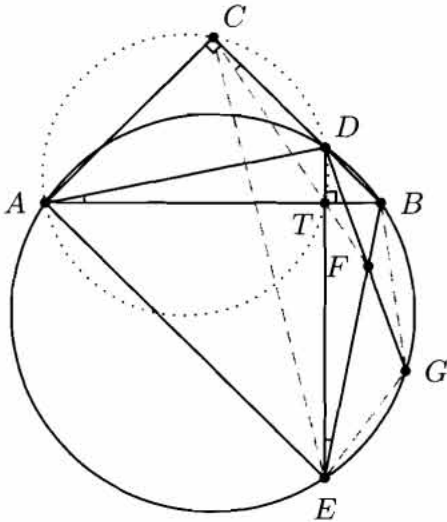
Figure 1

Want a route through all this instead of an archive? The track puts 2,604 problems in a working order, from Junior Challenge level to the IMO shortlist.

Source: MathNet, licensed CC-BY-4.0. Statement reproduced verbatim; metadata (topic, difficulty) added by this project.