Let be the circumcenter of triangle . Points , , lie on the segments , , respectively such that the circumcircles of triangles , , and pass through . Denote by the radical axis of the circle with center and radius and the circle with center and radius . Define and similarly. Prove that the lines , , form a triangle such that its orthocenter coincides with the orthocenter of triangle .
Iranian Mathematical Olympiad
Solution
Proof. We have and . So . Compute the other angles similarly. This way it is proved that the triangles are similar and is the orthocenter of triangle . Now, the altitudes of triangle make the same angle with the corresponding sides of triangle (angles and so on). So, the corresponding sides of the triangles also make the same angle.
Lemma 2. Let , be points on , respectively such that is cyclic. The circle with center passing through intersects the circle with center passing through at points namely , such that is on the circumcircle of and is on . Moreover, and the altitude of intersect on the circumcircle of .
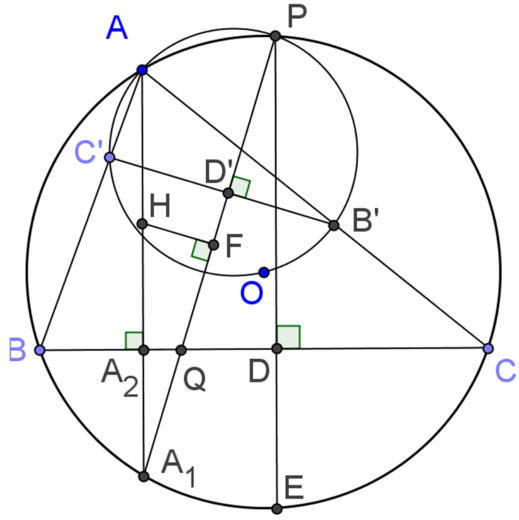
Proof. Let be the second intersection of the circumcircles of triangles and . We claim is on both , . We have
So, triangles and are isosceles and is on both , . Also, these triangles are similar. Let .
Triangles and are similar (Consider the angles of and the ratio of the sides incident with in these triangles). The ratio of similarity is and the corresponding sides make angles equal to . So, if , are the orthogonal projections of on and respectively, then and . So triangles and are similar. So, . Thus, if intersects at , then is the midpoint of the hypotenuse in the right angled triangle . So, is the perpendicular bisector of and is the second intersection of , .
Suppose and intersect the circumcircle of triangle for the second time at and respectively. We have
So, passes through and the lemma is proved.
According to lemma 2, the angle between and is equal to the angle between and . So, by lemma 1 the radical axes in the problem are obtained by rotating the altitudes of triangle with a fixed angle (but with different centers). The orientations of the rotations are the same, because all the equations in the proof remain valid by considering orientations. So, the triangle formed by the radical axes is similar to triangle . Therefore, it suffices to prove that the ratios of distances of from the radical axes is the same as the ratios of distances of from sides of triangle .
Let , be the orthogonal projections of on and as in the lemma. We have which is the same as the other ratios of distances of from the sides of the mentioned triangles. So the assertion is proved.
Want a route through all this instead of an archive? The track
puts 2,604 problems in a working order, from Junior Challenge level to the IMO shortlist.