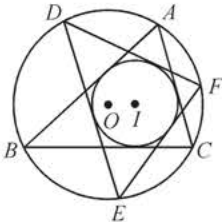
Let be the circumcenter and incenter of . Prove that, for an arbitrary point on the circle , one can construct a triangle , such that are the circumcenter and incenter of . (Posed by Tao Pingsheng)
China Southeastern Mathematical Olympiad
Solution
As shown in Fig. 2, let , , be the circumradius and incircle radius of . The point is the intersection of and the circle ; then
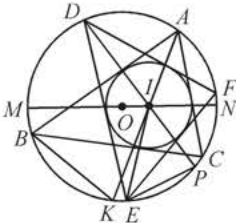
Fig. 2
Let the points be the intersections of the line and the circle ; then
i.e. .
Now draw the tangents from to the circle . The points are on the circle . Then is the bisector of . It is enough to prove that is tangent to the circle .
Let be the intersection of the line and the circle . Then is the midpoint of the arc , and
and so
As is on the bisector of , we can see that is the incenter of [because , and ; so ]. is tangent to the circle .
Want a route through all this instead of an archive? The track
puts 2,604 problems in a working order, from Junior Challenge level to the IMO shortlist.